Synopsis: College student Elgin Smith falls for fellow student Caroline upon seeing her one day in a restaurant, but the road to first love is paved with many obstacles.
Within a film history context: Movies which revolve around a soccer player protagonist have not been a common presence on American screens before FIRST LOVE in 1977. These pictures, though, appeared sporadically in mainly European films from the 1930s onwards. One of the first was Thorold Dickinson's British THE ARSENAL STADIUM MYSTERY (1939). In this movie, a soccer player is murdered, with his sporting teammates and girlfriend suspected of the crime. With the Russian TSENTR NAPADENIYA [CENTER FORWARD] (1947), directed by Semyon Derevyansky and Igor Zemgano, a soccer player's lives, both personal and professional, are depicted, particularly his relationship with his girlfriend. Kresimir Golik's Croatian film PLAVI 9 [THE BLUE 9] (1950) was about an egotistical soccer player who has a way with the ladies, but pursues a young woman, whose heart belongs to another. With the Italian GLI EROI DELLA DOMENICA [SUNDAY HEROES] (1952), directed by Mario Camerini, a soccer player indulges in suspect behaviour with his lover that may work against him in the end. Zoltan Fabri's Hungarian drama TWO HALF TIMES IN HELL (1961), was based upon a real-life incident, being a soccer match held between German, and Soviet soldiers during World War II.
Argentinian THAT FORWARD CENTER DIES AT DAWN (1961), directed by Rene Mugica, centered upon a talented soccer player whose transfer is purchased by a wealthy man, but their partnership ends in tragedy. Lighter in tone was Manuel Munoz and Alberto Mariscal's Mexican LAS CHIVAS RAYADAS (1964). Here, a young man aspires to play for a soccer team, while his siblings have other sporting ambitions. In contrast, intrigue was at the core of Polish film SWIETA WOJNA (1965), directed by Julian Dziedzina. Two soccer fans scheme to kidnap a player from their opposition team to skew the game in this comedy. Comedy was instead on the agenda in Kostas Karagiannis' Greek movie YVES! YVES! (1972). Members of an opposing soccer team scheme to derail a successful soccer player through the attentions of a woman, which works in the short term, but events conspire for the truth to emerge. FIRST LOVE differed from the above movies about soccer players for a number of important reasons.
FIEST LOVE lacks the comedy aspects which were present in YVES! YVES!, but concentrates more on the intimate amorous, and sexual life of Elgin. This is the predominant area where FIRST LOVE runs counter to all the other movies, although CENTER FORWARD and THE BLUE 9 do look at the personal lives of their main soccer player in some detail. FIRST LOVE also diverts in the area of plot, which marked pictures such as THE ARSENAL STADIUM MYSTERY, SUNDAY HEROES, and THAT FORWARD CENTER DIED AT DAWN. There is a lack of suspense in FIRST LOVE, instead a leisurely sojourn into Elgin's comings and goings. No red herrings or twists and turns, but a more character-driven view of the life of a soccer player. One of the most measured, direct films revolving around a soccer player, FIRST LOVE distinguishes itself with its down-to-earth presentation and execution.
Overview: Joan Darling has been an actress and director on many television series over the years, with several film acting credits. Miss Darling directed two motion pictures in her career, with THE CHECK IS IN THE MAIL (1986) her second movie. A man decides upon a life change by living off the grid, under difficult conditions, but finds his life is anything but idyllic in its new incarnation. With a cast including Brian Dennehy in the lead, and support from Anne Archer as his wife, it has sunk into oblivion. FIRST LOVE, though, was Joan Darling's first picture as a director, and her best-known film.
With FIRST LOVE, Joan Darling made an interesting directorial debut. The tale of an idealistic college student seeking Miss Right, falling deeply in love with a young woman, but finding things are more complicated than first thought, is handled nicely by the director. The movie has a pensive tone, and graceful pace, which provides it with a warmth, and a lyrical feel. The storyline is fluid in its execution, reflecting life itself, with different characters moving in, and out of the narrative with assurance. There is an intimacy about this film, and how it manages to get to the heart of its characters' innermost thoughts and feelings. It views its characters with sympathy, and this allows the audience to judge them as real people, despite their many flaws. For a film that tackles the topic of love, it does not have a mushiness about it, but is more adult in nature than most. There is talk of poetry and literature which is in keeping with the movie's academic setting, and this suits the material. While this is all admirable to witness, the movie does have a number of shortcomings which hamper the overall impact the director has attempted to achieve.
Weaving characters in and out of the specific stories gives a naturalness to the proceedings, but sometimes, there is a wish that deeper knowledge of events would have been beneficial overall. This would have made characters even more three-dimensional than they already are. Caroline is a prime example of this. An interesting, complex character, and pivotal in the life of Elgin, her personal life has been glossed over in FIRST LOVE. There was some mention of her father, and his emotional problems, which seemed to influence her view on life, and men, but this was not explored in enough detail. More attention in the movie has been given to the various love scenes than getting into the mind of Caroline, which is dispiriting. Shelley suffers a similar fate here. She is a truckload of insecurities and neuroses that the movie hints at, but we only partially see these, even though the presentation of these is of a high standard. It seems as if Shelley is more about getting Elgin into bed, when things are much deeper than this. In addition, David and Shelley are not seen together as a couple which would have been a nice contrast to Elgin and Caroline. This would have imbued the movie with more balance, and something to bounce off. Despite these weaknesses, FIRST LOVE is a passable motion picture which deserves to be seen, and notable as a movie by a female director in 1970s Hollywood.
Acting: Five performers in FIRST LOVE are notable for their contributions to the movie. William Katt is perfect as Elgin, the film's lead character. His sheer belief in the material, creating a character who he transforms into a real person onscreen, Mr Katt's presence is the key to why the picture remains watchable despite some lulls. As Caroline, the young woman who captures Elgin's attention, Susan Dey makes what could have been a one-note, overly fey character into someone likable, with a shattering psychological makeup that makes Caroline a complex figure indeed. The needy and lovable Shelley has been given an expert interpretation by Beverly D'Angelo. An actress with a penchant for comedy, this is in evidence here, but with a dramatic backbone, giving Shelley an undertone of sadness. Shelley's other half is in the person of John Heard as David. As with Miss D'Angelo, Mr Heard has a way with comedy, and it is disappointing that they are not used together sufficiently. Another actor with a zany way of doing things is Tom Lacy as college Professor Oxtan. While his character has a small part in the movie, Mr Lacy is remembered for his subtle comic reactions to situations, such as when Elgin fails to serve him his coffee, which is priceless to witness.
Soundtrack: FIRST LOVE has a spare but effective soundtrack which exemplifies the thoughtful tone the movie does so well. Most prominent are Paul Williams' dreamy, ethereal song 'That's Enough for Me' which is played during the train scene with Elgin and Caroline, and Cat Stevens' 'Child For A Day'. The latter is employed both during the opening, and closing credits, something in common with many 1970s pictures, in seeking to display the change of events, and character knowledge, from the movie's beginning, to end.
Mise-en-scene: A number of elements have been successfully fused to create the lush aura which permeates FIRST LOVE. Cinematography by Bobby Byrne bathes the movie in a relaxing glow with his work here. Exteriors in particular are noteworthy, with the soccer field on which Elgin plays, the outside of the college, and the leafy areas where Elgin and Caroline meet all beautifully captured. Costuming by Donfeld is in keeping with the subtle tone of the movie, the cast all dressed in an elegant, low-key manner. The jackets and coats worn by Susan Dey are chic, indicating her high socio-economic standing in a stylish manner. Production design by Robert Luthardt is excellent, giving both a realism, and warmth, to areas such as the cafe where Elgin works, Caroline's family home, and Elgin's dormitory room, to name a few examples.
Notable Acting Performances: William Katt, Susan Dey, Beverly D'Angelo, John Heard. Tom Lacy.
Suitability for young viewers: No. Infrequent coarse language, male nudity, female nudity, adult themes.
Synopsis: An unconventional friendship is forged between two men, Dead Eye Dick and Mexico Pete, after Dick saves Pete from a precarious situation one evening.
Within a film history context: Australian sex comedies began to appear on cinema screens from 1970. Due to the breakdown of Australian film censorship, and a relaxation of what content could appear on screen, sex comedies began to be made from 1970, beginning to largely peter out by 1975. The first of the genre, John B. Murray's THE NAKED BUNYIP (1970) was a semi-documentary about the sexual habits of Australians, with a young man interviewing various people about the topic. It is seen as being not only a milestone in Australian film censorship but also, inaugurated the sex comedy genre in the country. Next came STORK (1971), directed by Tim Burstall. The story of a young man, and his libidinous adventures resonated with the viewing public, as with THE NAKED BUNYIP, and was one of the most successful Australian films until that time. 1973 brought one of the most notable sex comedies produced in the genre, being Tim Burstall's ALVIN PURPLE (1973). As with STORK, it centred around a young man and his raunchy activities, but ALVIN PURPLE went much further in this department, with a preponderance of nudity, specifically female, and sexual situations. The film was an immense financial success of its time and led to a sequel in 1974, ALVIN RIDES AGAIN, and another in 1984, being MELVIN, SON OF ALVIN, although both were not as profitable as the original.
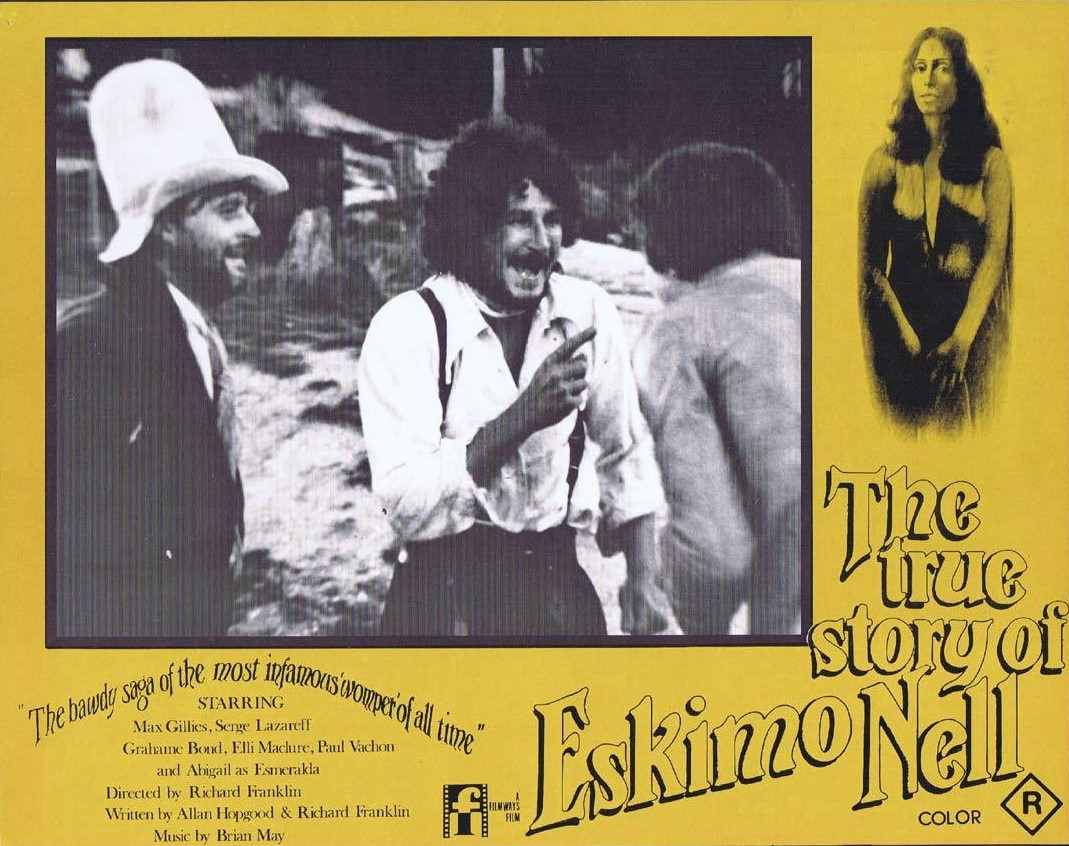
1975 was notable as a year in which several Australian sex comedies were released, but the impact of earlier productions was not obvious in their box office takings, which were disappointing. THE BOX (1975), directed by Paul Eddey, was a comedy about the goings-on at a fictional television station, and contained a subplot about the entanglements of an ambitious, promiscuous starlet. David Baker's THE GREAT MACARTHY (1975) had an attractive football player whose romantic rendezvous with three different women were charted in this brassy production. THE LOVE EPIDEMIC (1975), directed by Brian Trenchard-Smith, as with THE NAKED BUNYIP, had a documentary leaning, but this time concerned with venereal disease, with some comic asides, and plenty of sex and nudity. Terry Bourke's PLUGG (1975) was an abysmal sex comedy of a private detective on the trail of an elusive female escort, with others also hot on her trail. It was, unfortunately, the lesser of all the Australian sex comedies. In comparison, THE TRUE STORY OF ESKIMO NELL was also released in 1975 at the end of the Australian sex comedy cycle, and is the best of all the movies in the genre.
The movie does have that nonsensical approach to its narrative, and emphasis on sexual matters which marked entries such as ALVIN PURPLE, THE LOVE EPIDEMIC, PLUGG, THE NAKED BUNYIP and, to a lesser extent, THE GREAT MACARTHY. There are depictions of sex and nudity which also definitely earned the first three examples, as well as THE TRUE STORY OF ESKIMO NELL, their 'R' rating restricted certificates, making these films only accessible to adults in the cinema. THE TRUE STORY OF ESKIMO NELL, though, moved away from these in one main manner. While there was a small degree of pathos present in STORK and ALVIN PURPLE, in THE TRUE STORY OF ESKIMO NELL it beautifully infused the picture with its unique tone. Instead of sexuality being a means to an end in the movie, as it was, for example, in ALVIN PURPLE, with a male character sowing his oats, Dead Eye Dick in THE TRUE STORY OF ESKIMO NELL was searching for something of a more spiritual, otherworldly plane. It was not just about the sex here, but about the journey. He does save himself for someone, and something which was utterly contrary in reality to what it was in mythology, and this gave the film its sweet, sad, and emotional feel. In addition to this, there is another feature of THE TRUE STORY OF ESKIMO NELL which separates it from the others in the genre.
The other movies generally concentrated upon a single male character, following his life and, especially, various adventures and dalliances with women. This was a key tenet of STORK, ALVIN PURPLE, THE GREAT MACARTHY, and PLUGG. With THE TRUE STORY OF ESKIMO NELL, it moves away from this single character structure. There are contrasts drawn between the two male characters, being Dead Eye Dick, and Mexico Pete in THE TRUE STORY OF ESKIMO NELL. The former is the unconfident male protagonist, uncomfortable around women, the latter his polar opposite, who had a definite way with the ladies. The path to which Dick and Pete become best friends is one of the most charming aspects of the film. Women notwithstanding, their friendship deepens, and here this male-male friendship blossoms, and finds its zenith at the conclusion of the picture. In effect, THE TRUE STORY OF ESKIMO NELL is a bromance film, moving away from just being about men and their sexual desires, to something more substantial. A great movie with a definite raison d'etre, THE TRUE STORY OF ESKIMO NELL is not only entertaining but also, offers food for thought about male-male friendships, and humanity itself.
Overview: Richard Franklin was an Australian director who made eleven films between 1975 and 2003. Over this twenty-eight-year period he tackled genres such as comedy, sex comedy, horror, and action. His second movie, the softcore FANTASM (1976) was an anthology picture dealing with female sexual desire, presenting these in a no holds barred fashion, with many American pornographic models acting in these segments. It was strung together with a faux psychiatrist introducing these, but the film itself was a success at the Australian box office. Next came horror film PATRICK (1978), a definite change of pace for the director. A murderous comatose patient causes no end of grief in a hospital in a bid to keep his private nurse with him. More horror was on view in ROADGAMES (1981). A truck driver begins to believe that a man is murdering young hitchhikers, enlisting the assistance of a young woman to find the killer. In 1983 one of his best-known films was released, being PSYCHO II (1983). The continuation of the story of creepy Norman Bates, proprietor of the Bates Motel, it was one of Mr Franklin's most commercially successful movies, grossing a healthy profit. Another horror film, LINK (1986), had a zoology student becoming involved in experiments with chimpanzees, the animals turning against her in a dramatic manner.
More American films followed for Richard Franklin. Action was the main attraction in F/X2 (1991). A special effects man becomes involved in intrigue and murder, specifically to find a killer in this action movie. Richard Franklin returned to more character-driven material with HOTEL SORRENTO (1995). In this picture, a woman returns to her hometown, and after enjoying the success of her novel, this causes problems as the fiction in this case may be based more in fact than first meets the eye. Mr Franklin's penultimate film was BRILLIANT LIES (1996). Sexual harassment was the focus here, with a woman taking her former employer to court for goading her to have sex with him. Richard Franklin's final cinematic outing, VISITORS (2003), was another foray into horror for the director. This film looked at a young woman who sailed on her own around the world, and charted her crumbling mental state. THE TRUE STORY OF ESKIMO NELL marked Richard Franklin's film debut, and was one of his most original works.
With THE TRUE STORY OF ESKIMO NELL, Richard Franklin has made a striking motion picture which rings true in every way. Taking the story of an unlikely friendship between two very contrasting men, Dead Eye Dick and Mexico Pete, the film depicts their bond, from Mexico Pete's initial misgivings about Dick, their developing camaraderie, to events which cement their union. It is a movie which slowly unravels in an entertaining, but also, heartfelt style, making one care about the characters, and what happens to them. The film, admittedly, does have a preoccupation with sexual matters, but these come from the characters, and are not forced. The sexuality, nudity, and language are surface aspects which give way to deeper ponderings, and explorations of male-female, and male-male relationships. It may seem to be a film that is light on first impression, but this is dispelled when it is looked at in more detail.
The movie does posit overwhelming support for male-male friendships within its context, and how women sometimes can be expendable in this respect. To maintain balance the film, though, does contain a scene where Dick and prostitute Ellie do relate on a more profound emotional level as a man and a woman. The variety of elements in the film, though, makes one definite statement about THE TRUE STORY OF ESKIMO NELL. Although the movie is at heart a western with comedy asides, it does have a little of everything, but never becomes overloaded. Comedy, drama, male wish fulfilment, fantasy, tragedy, for example, all receive an airing in THE TRUE STORY OF ESKIMO NELL. Richard Franklin succeeds in keeping everything on an even keel, and when one thinks the movie will go overboard, he pulls back, surprising the audience in the process. One of the most imaginative Australian movies ever, THE TRUE STORY OF ESKIMO NELL deserves a higher critical reception than what it has previously received, and for its director.
Acting: THE TRUE STORY OF ESKIMO NELL benefits from its two main performances, and two supporting contributions. In the lead role of Dead Eye Dick, Max Gillies is excellent. An actor renowned for his impersonations of various real-life figures, here he makes his character not only humorous but also sympathetic, warm, and thoroughly relatable. As his best friend, and cohort Mexico Pete, Serge Lazareff also does a fantastic job. With his likable swagger and way with slang, he and Max Gillies have a chemistry that makes the movie a convincing experience, despite its many raunchy passages. Graham Bond as Bogger, Pete's friend, lends his considerable liveliness to a small part which, nevertheless, adds spice to the movie. The final acting of note was by Elli Maclure as Ellie, a prostitute with whom Dick has a revealing heart to heart talk. An actress who has played in several movies, more on television, here provides an insightful, candid performance which gives another view of femininity which is in contrast to the film's concentration on female nudity.
Soundtrack: Brian May's music for THE TRUE STORY OF ESKIMO NELL ticks all the boxes in terms of the feelings the movie encompasses. Happiness, sadness, pathos, slapstick, hilarity, and many other states, are all expertly evinced by Mr May in his work, immeasurably assisting the movie.
Mise-en-scene: Several personnel have made notable contributions in making THE TRUE STORY OF ESKIMO NELL persuasive onscreen for viewers. Colour cinematography by Vincent Monton is beautiful, capturing hues in a lavish, yet agreeable manner. One of the best uses of colour is the scene where Dick rescues Nell, reminiscent of the ice floe sequence of WAY DOWN EAST. Art direction by Josephine Ford and Ray Wilkinson creates a wild west which convinces not only visually in its detail but also, has an endearing nature of familiarity in its tone. Costuming by Aphrodite Kondos captures the personalities of all characters to a tee, from Dead Eye Dick to Mexico Pete, Bogger to Eskimo Nell herself.
Notable Acting Performances: Max Gillies, Serge Lazareff, Graham Bond, Elli Maclure.
Suitability for young viewers: No. Infrequent coarse language, male nudity, female nudity, adult themes, medium-level violence.
Title: THE COOLANGATTA GOLD (Alternate title: THE GOLD AND THE GLORY)
Year of Release: 1984
Director: Igor Auzins
Genre: Drama, Sport, Romance
Synopsis: Two brothers aim to compete in The Coolangatta Gold iron man race to appease their father, but he only supports the aspirations of his eldest son in this, causing a rift with his younger son.
Within a film history context: Films with a father-son conflict at their core have been in existence in cinema history since the sound era, with several notable examples. One of the first documented was F.W. Murnau's CITY GIRL (1930). In this movie, a woman marries a farmer, but has to face many difficult situations in her new life. Adding to her issues is the fact that her father-in-law refuses to accept her, this causing a wedge not only in her marriage but also, between father and son. With the exotic FIESTA (1947), directed by Richard Thorpe, a young man does not want to follow in his father's footsteps as a matador, this causing dissension between them, and complicating his sister's life in the process. Mervyn LeRoy's ANY NUMBER CAN PLAY (1949), featured Clark Gable as a casino proprietor whose activities impact not only upon his wife but also, his son, who disagrees with his father's business dealings. CONFIDENTIALLY CONNIE (1953), directed by Edward Buzzell, was of a more comic persuasion. It focused upon a college professor and his wife, and his father with whom he is at odds over the family ranch, where he does not wish to return.
Edward Dmytryk's BROKEN LANCE (1954) followed a crusty ranch owner, and his four sons. Conflict emerges from how he treats the three older sons of his first marriage, and the very different, close relationship he shares with the youngest son from his second marriage. Western THE HALLIDAY BRAND (1957), directed by Joseph H. Lewis, concentrated upon the wrought relationship between a son and his father, who was an unorthodox sheriff who tried his best to control the lives of him and his siblings, his one son the only person able to take him on. An aristocratic take on matters was offered by Terence Young's MAYERLING (1968). An Austrian prince has a hostile relationship with his father, due in part to the patriarch's insistence on maintaining the status quo of the social order, his son holding more contemporary beliefs in 1880s Austria. Devious doings were the order of the day in THE HORROR OF FRANKENSTEIN (1970), directed by Jimmy Sangster. An utterly odious young man has a falling out with his father over his anatomy experiments, and subsequently kills him, continuing his mission to construct a body, which causes no end of grief. THE COOLANGATTA GOLD was a movie where the father-son conflict was one of the main drivers of action in the narrative.
The father-son difficulties were largely based upon the father's insecurities in THE COOLANGATTA GOLD, and how he came second in a surfing marathon in 1960. The father sees his younger son as the weak link in the family, as he is more motivated toward artistic pursuits such as being a rock band promoter, rather than an athlete. The son sees life in a less competitive manner, just wanting to do what he does, without the burden of being the best. He is constantly berated and belittled by the father, who sees the older son, and brother, as the child who will fulfill his dream of winning the surfing marathon. There are, in effect, elements of the stage father in this movie, which is far removed from the other portrayals, with fathers and sons not connecting for one reason or another.
FIESTA and CONFIDENTIALLY CONNIE had sons who did not want to continue in the life goals of their respective fathers, but THE COOLANGATTA GOLD stood out as the younger son actually wanted the love and esteem of his father, and tried to please him, but could not achieve this. The father could never see the younger son for who he was, and what he wanted out of life. In THE COOLANGATTA GOLD, it was always about what the father wanted for his sons, but not what they wanted for themselves. There was a tragic undertone to the movie where two family members could never see eye to eye, with feelings of resentment expertly depicted. It could be said that Steve in THE COOLANGATTA GOLD was similar to the son in THE HALLIDAY BRAND who tried to break away from his father's influence and carve his own identity. The use of the love interest in THE COOLANGATTA GOLD is also something which diverts from other movies with a father-son conflict.
In CITY GIRL, the father-in-law causes his new daughter-in-law many precarious moments, and, in turn, his son with the treatment of his wife. The wife in ANY NUMBER CAN PLAY is neglected by the husband for his work, and in MAYERLING, the prince has an affair with another woman to take his mind away from his loveless marriage. In THE COOLANGATTA GOLD, matters are much more subtle, and muted in tone. There is none of the melodrama which marked the other movies, but Steve and Kerri meld together in a natural way, real life and emotions making an impact on them. A backwards and forwards momentum marks their union, with Steve's personal, and professional difficulties highlighted, and Kerri's ballet obligations the issues. In addition, Steve's father views his attraction to Kerri as humorous, which is another deviation from the above movies, and view of male-female relationships, and prospective father-in-law. Steve's father does not even exchange a word with his son's love, even though he sees his son speaking with her on the beach, and at the hospital. For these reasons, offering a meaty view of father-son conflict, THE COOLANGATTA GOLD is one of the most extensive on the topic.
Overview: Igor Auzins is an Australian director who has helmed three motion pictures, being more active on television in episodic series, and telemovies. His first movie, HIGH ROLLING (1977), was a rollicking action film about the adventures of two carnival workers, with Joseph Bottoms in the lead role. Mr Auzins' second movie, WE OF THE NEVER NEVER (1982), was an historical story set in early 1900s Australia which had a warm critical reception at the time of its release. It also received a number of awards and nominations in various departments. THE COOLANGATTA GOLD was Igor Auzins' last movie, and one of his most-recognized cinematic efforts.
With THE COOLANGATTA GOLD, Igor Auzins has crafted a strong film which makes a definite impression on the emotions. Taking a deceptively simple narrative line by exploring a family, and how a father wants his eldest son to win an ironman race, effectively casting his younger son aside in the process, it keeps the spectator involved with the various viewpoints, and character desires and needs that are expressed. While there are some fiery moments, these are not forced, and come from the characters with a basis in honesty. The movie itself plays out in a naturalistic manner, eschewing obvious melodrama that can sometimes be jarring. This is one of the merits of THE COOLANGATTA GOLD, being that it is never over the top in its execution. Although the film has certain assets, it does, unfortunately, have downsides which take it down a few notches.
The first half of the movie does establish what is taking place, where, how, and why, but one wishes some sections could have been abbreviated. Several examples come to mind. The sequence where it is revealed that Steve aspires to be a rock band promoter, with the band playing a song in the background, while valuable as insight into his ambitions, is overlong. The song played also is not memorable in any way, especially when compared to a later song in the roof garden scene played by the band. The roof garden scene itself also takes too long to unravel, but the movie makes up for this with Adam's predicament, and the fallout from this. In addition, the later love scene between Steve and Kerri was a tacky 1980s segment that did absolutely nothing to further the story. As with the previously mentioned scenes, it was presumably included to be fashionable for its time, but all seem dated in retrospect. Thankfully, the second half of the movie picks up steam, and the various confrontations and character interactions are closer in proximity, making for a better film. The ending of the film is excellent, where all the pieces come together in a cohesive whole. In looking at the movie as a whole, certain things can be said about THE COOLANGATTA GOLD. It is a stirring film which deserves a higher reputation than what it has had in the past for the affecting experience it delivers to the viewer.
Acting: THE COOLANGATTA GOLD boasts fine performances from its cast which bolster its impact. In the lead role of Steve Lucas, a young man seeking to attain his father's love, but finding this an impossible task, Joss McWilliam is excellent. An actor for whom this was his debut role, he makes Steve a person of many edges, with passion, humor, anger, and sensitivity recalling the volatility James Dean displayed in his parts. As Joe, his father, and the thorn in Steve's side, Nick Tate shows why he is one of Australia's best actors. A performer adept at playing all sides of the emotional spectrum, his Joe could have been a caricature in other hands, but he manages to make him understandable and even sympathetic, despite Joe's treatment of his son. Colin Friels, as the favourite son of Joe, Adam, makes him a strong, but often silent figure in the movie. An actor who instinctively knows how to use his face and eyes, saying much in a non-verbal manner, Mr Friels is another attraction in the picture. His dance scene with Josephine Smulders' Kerri shows him an ace on the floor with his moves. Three other actors contribute great acting in the movie.
As Robyn, wife of Joe, and mother of Steve and Adam, Robyn Nevin is well-cast in a small role which she nevertheless makes the most of in the limited time she has onscreen. An actress who always brings conviction to her parts, making her characters believable to the core, she gives another viewpoint to the film, taking some attention away from the largely all-male perspective displayed. The ballerina who captures Steve's heart is given subtle treatment by Josephine Smulders. A ballerina in real-life for whom this was her only screen role, she is well-matched with Joss McWilliam, her serene and thoughtful nature a nice contrast to Steve's excitability and nerviness. The last actor of note in the film is Paul Starling as Steve's karate instructor. In real-life Mr Starling is a martial artist and karate master, and in the movie brings notes of authority and determination to his role as Steve's instructor, and closest confidant.
Soundtrack: What is most striking about musical accompaniment in THE COOLANGATTA GOLD is Bill Conti's rousing score. It is alternately quiet, passionate, spirited, and suits the story of people striving for the best they can achieve. Additionally, it provided the film with a sense of wonder and grandeur that the visuals many times lack, making up for this considerably. Aside from this, the movie has several rock and pop tunes which do not make an impression on the senses, the best of all these being 'Fraction Too Much Friction', performed by Wilbur Wilde. It functions not only in a pleasant manner, but also as a diegetic comment on the lives of its characters, particularly brothers Steve and Adam in this part of the movie.
Mise-en-scene: What appears onscreen for viewers in THE COOLANAGATTA GOLD is one of its most problematic aspects. On the one hand, cinematography by Keith Wagstaff is crisp and clear, especially beautiful during the scenes on the beach such as the iron man race, taking advantage of the sun-drenched locations. On the other hand, the locations chosen for the movie, such as the Lucas family home and its surroundings, are unattractive, and do nothing for the film. It could be said that the family home is reflective of its characters, but visually is a liability. This, though, is symptomatic of many Australian films over the years, being how unappealing locations are spotlighted, possibly to create an image of realism, but they offer nothing but an eyesore to viewers. There is also the tendency to plunge the movie into darkness at times, such as the roof garden scene, the car park sequence, and, the private areas of the Lucas family home. Having more agreeable locales would have given the film a boost that the sets and places it utilized just do not possess. In the case of THE COOLANGATTA GOLD, these are not the best backdrop for its excellent cast, failing to serve them properly.
Notable Acting Performances: Joss McWilliam, Nick Tate, Colin Friels, Robyn Nevin, Josephine Smulders, Paul Starling.
Suitability for young viewers: Parental discretion advised. Infrequent coarse language, brief male nudity, brief female nudity, adult themes.
Synopsis: A professional motorcycle racer befriends an amateur racer in Arizona, and subsequently compete not only in business but also, in love.
Within a film history context: Movies with motorcycle racer protagonists, competing in professional races, sometimes appeared in cinema before 1970. This was in comparison to the many films which featured motorcycle racing characters who did this as a leisure pursuit, or in a rebellious vein. Bernard Vorhaus' MONEY FOR SPEED (1933) was about the world of speedway racing, concentrating upon the romantic pursuits of its leading men, along with their personal competitiveness. Comedy movie NO LIMIT (1935), directed by Monty Banks, followed a chimney sweep who longs to compete in a motorcycle racing event, and achieves this, but faces competition from other racers. Jack Lee's ONCE A JOLLY SWAGMAN (1949) focused upon a motorcycle racer whose professional life affects his relationship with his wife. In contrast THE PACE THAT THRILLS (1952), directed by Leon Barsha, emphasized a love triangle between two motorcycle racers, and a reporter who covers their exploits for a newspaper. LITTLE FAUSS AND BIG HALSY was a picture that closely followed the lives of motorcycle racers, something the other entries also did, but branched out into fresh territory with its content.
As with all the other films, LITTLE FAUSS AND BIG HALSY had plenty of motorcycle action, something which added excitement and life to the narrative, and visual appeal for the viewer. The difference with LITTLE FAUSS AND BIG HALSY was the shooting of the movie in a rugged landscape. It was unlike NO LIMIT, and THE PACE THAT THRILLS, which had extensive outdoor shooting, but whose locations were of a more conventional nature. ONCE A JOLLY SWAGMAN differed again as much of the motorcycle sequences were based inside a racetrack setting. With LITTLE FAUSS AND BIG HALSY, the outdoor motorcycle segments took on a life of their own for their sheer authenticity. The dustiness of the long country roads, the sun beating down on those below, both participants and spectators, gave the impression of beautiful, but torturous terrain. This was a subtle metaphor for the difficulties of being a member of the motorcycle racing/dirt bike racing sport that the movie examined. Other features of LITTLE FAUSS AND BIG HALSY provided divergence from the other motorcycle racing films.
NO LIMIT'S slight romantic arc was not as pronounced as the following three examples. MONEY FOR SPEED, ONCE A JOLLY SWAGMAN, and THE PACE THAT THRILLS, on the other hand, had a predominant romance angle which dominated the movie. The first film had two men competing both personally, and in a professional sense. The second had more domestic leanings, with a racer's marriage impacted by his occupation. The third had a love triangle between two men, and a woman. LITTLE FAUSS AND BIG HALSY, in comparison, veered away from these scenarios. The rivalry between two men in both sport, and love was the spotlight, but was looser in the execution of its plotting, preferring a freeform structure. Neither Little Fauss, nor Big Halsy end up in a happy union with a woman, which was in opposition to NO LIMIT, MONEY FOR SPEED, ONCE A JOLLY SWAGMAN, or THE PACE THAT THRILLS. No stable male-female relationships eventuate, instead, a series of flings take place. Aside from this, LITTLE FAUSS AND BIG HALSY was made in 1970, and a relaxation in film censorship allowed for more openness in sexual content, and nudity, which the previous films, made in the 1930s, 1940s, and 1950s, could not depict. This had the effect of making the movie more liberal than its counterparts in terms of what appeared on the screen. A sojourn into the lives of motorcycle racers, LITTLE FAUSS AND BIG HALSY is an enjoyable film.
Overview: Sidney J. Furie is a prolific filmmaker who, over the course of his sixty-five year career, has directed forty-six feature films. Mr Furie is a generalist who has made movies in a number of genres, from crime, action, adventure, comedy to romance. His first film, A DANGEROUS AGE (1957) was a romance which charted the obstacles two young people faced in becoming a couple. Into the 1960s, he made THE BOYS (1962). A drama set in 1960s London, it followed the exploits of four teenagers involved in crime, a theme which Mr Furie explored on various occasions in his career. His next notable film was THE LEATHER BOYS (1964). This was the story of a young woman who marries a biker, thus explaining the leather of the title, and how his relationship with his friend impacts on the marriage. Starring a largely British cast, it was another step forward for Mr Furie in making daring movies. 1965 brought THE IPCRESS FILE to audiences. A thriller of espionage and double-cross, again with a British cast including Michael Caine and Gordon Jackson, it is noteworthy as a predecessor for the theme Mr Furie would later investigate in HIT! As a change of pace, Sidney Furie then tackled the action-romance genre in THE APPALOOSA (1966). Starring Marlon Brando, it focused upon a man's quest to take back his horse which has been appropriated by a Mexican man. The 1970s was a time of growth for Mr Furie, when he would make films about copious themes.
With the inception of the 1970s, Sidney Furie released THE LAWYER (1970). It followed a lawyer who becomes involved in a murder case, something different for the director. Mr Furie then filmed the biography of singer Billie Holliday, LADY SINGS THE BLUES (1972). With Diana Ross as Miss Holliday, it was one of his most famous, well-remembered movies, with memorable musical trimmings. HIT! (1973) was the story of a federal agent seeking to take down drug traffickers after the death of his daughter from an overdose. The remainder of the 1970s featured various types of movies in Mr Furie's oeuvre. SHEILA LEVINE IS DEAD AND LIVING IN NEW YORK (1975) gave Sidney Furie the opportunity to display his aptitude for comedy. In this movie, a young woman moves to New York City and finds love. Mr Furie again tackled a biographical film, GABLE AND LOMBARD (1976). The story of Clark Gable and his ill-fated wife Carole Lombard, it was a movie of a more romantic nature than usual, but critically derided upon release. Sidney Furie looked at Vietnam with THE BOYS IN COMPANY C (1977). A film with much profanity, it provided its cast with a realistic story about a boot camp that turns into a nightmare once the soldiers arrive in Vietnam.
In the 1980s Mr Furie's movies were not as prominent as his 1970s pictures. After uncredited direction on two movies, he made THE ENTITY (1982). A horror film about a woman who is menaced by a demon she cannot see but of which she can definitely feel the presence, it was the first time he had made a horror genre entry. With PURPLE HEARTS (1984), Mr Furie revisited Vietnam, this time charting the love story of a doctor and a nurse. The remainder of the decade was devoted to two instalments of the IRON EAGLE franchise in 1986 and 1988 respectively, and, in 1987, a film in the Superman franchise, SUPERMAN IV: THE QUEST FOR PEACE. His films in the 1990s until the present are a mixture of his previous movies, mainly action movies, thrillers, war, and comedy. Looking overall at the sheer scope of his works, LITTLE FAUSS AND BIG HALSY was one of Sidney Furie's lighter, but still satisfactory films.
With LITTLE FAUSS AND BIG HALSY, Sidney Furie has fashioned a diverting, fast-moving movie. It is the character study of Halsy Knox, a motorcycle racer, his friend Little Fauss, and various other uninhibited personalities they encounter along their journey together. The film depicts the rootless life of its central protagonist with vigor, showcasing him in different situations which ably express his nonconformist attitudes toward life and, in particular, his amorous entanglements with the opposite sex. It contrasts Halsy's swagger, and good looks to Fauss' less confident disposition, and lack of physical attractiveness. Aside from the central pair, the film also delineates their lives through their relationships with others, which give both Halsy and Little Fauss depth. The women they meet and are involved with, such as Rita and, in particular, Fauss' parents, also reveal other sides to these two characters. While LITTLE FAUSS AND BIG HALSY has some positive traits, there are a number of striking flaws evident when the movie is considered as a whole.
Admittedly, the freewheeling nature of the movie is something which gives it a certain offbeat appeal, but, unfortunately, this has been transferred to the film, causing it to lack continuity in certain departments. It would have been helpful if there was more of a backstory for Halsy, to explain why he acted the way he did. This is also applicable to Fauss, even though his parents appear, which is one of the movie's best aspects. In addition, the treatment of women in the film is lamentable, as they are largely painted as floozies with a body, and without psychological complexity. Rita, for example, seems to serve a purpose for a spell, but then is gone. In an attempt to maintain an organizing structure in the movie, it is admirable that the focus is contained to both Halsy and Fauss, but this is often to the detriment of peripheral characters. The major case of this is the death of Fauss' father, which is something that should have been given greater weight, but which is glossed over.
Other omissions do hinder the tapestry of LITTLE FAUSS AND BIG HALSY. The movie, overall, does have issues with making events moving to the audience, with the effect that the picture is often apathetic toward depicting real emotions. The film's tendency to jump from one situation to another may seem fashionable, but leaves spectators with a feeling that something is lacking to make things compelling. If there were more highly charged moments of anger and sadness these would have made all the difference. It would have balanced the hijinks and frivolity, thus giving these a better place in the story. All in all, though, certain things can be said about LITTLE FAUSS AND BIG HALSY, despite its shortcomings. It is a likeable movie that tried to be in the here and now, but missed out on involving its audience in a more riveting manner.
Acting: Several performances stand out in LITTLE FAUSS AND BIG HALSY for their authenticity. As Halsy Knox, the hard living, womanizing half of the eponymous duo, Robert Redford contributes yet another thoughtful screen interpretation. An actor with an air of profundity and ease, he makes his rogue someone very difficult to dislike, despite the character's behaviour and actions. The other half of this twosome is Little Fauss, played by Michael Pollard. A character actor whose soft voice and seemingly diffident manner made him perfect for roles in action or rural themed movies, he makes Little Fauss one more of his unique parts. As a side note what is also interesting about the movie is how there is no real chemistry between Halsy and Little Fauss. While they are distinctive as individual characters, as a combination the fire that should have been there is nowhere to be seen.
The main female character is not the most memorable in the movie for certain reasons. Unfortunately, the film is not a proper showcase for Lauren Hutton as Rita Nebraska, Halsy's lover. An actress whose smoky voice and demeanor is more befitted to films with glamorous locales and parts as sophisticated women, here she is not allowed to display her talent in a largely thankless role. On the other hand, Noah Beery Jr. and Lucille Benson as Seally Fauss and Mom Fauss, Little Fauss' parents, are captivating. Like two peas in a pod, these character actors give the movie an undertone of subtle humor, of people who have seen the best, and worst in life, and beautifully round out the acting in LITTLE FAUSS AND BIG HALSY.
Soundtrack: There are a number of tunes featured in LITTLE FAUSS AND BIG HALSY, but the most prominent is Johnny Cash's 'Ballad of Little Fauss and Big Halsy'. It is played at both the beginning, and end of the movie, similar to many 1970s films, and supplies an appropriate non-diegetic commentary on the characters, and their picaresque lives.
Mise-en-scene: What appears in front of the camera has been carefully considered in LITTLE FAUSS AND BIG HALSY. Cinematographer Ralph Woolsey photographs the movie in his usual effective way, in this case, making the harsh Arizona landscapes take on an unexpected beauty of their own. Locations are also well-selected, giving the impression of people living difficult lives but also, enjoying these at the same time. The motorcycle racing sequences are all exciting to watch, never giving the impression of artificiality, but of immediacy.
Notable Acting Performances: Robert Redford, Michael Pollard, Noah Beery Jr., Lucille Benson.
Suitability for young viewers: No. Infrequent coarse language, female nudity, adult themes.
I am very happy today to welcome actress Manuela Thiess Garcia back to CINEMATIC REVELATIONS. Manuela has been on the blog previously speaking about her role in CHANGES, and many other topics; the interview can be found here. In this post, we will be taking things in an entirely academic, but nevertheless, absorbing direction. Manuela will be discussing a number of fascinating topics close to her heart such as politics, existential philosophy, science, psychology, and biology.
Welcome back to CINEMATIC REVELATIONS Manuela!
Athan: Politics is a subject of interest the world over, and a matter of contention in many an instance. What is it that you find most interesting about politics?
Manuela: To not be concerned about what is going on in the world politically is to not be engaged in what controls your life. I think it essential to inform ourselves about the politics around us, so that if need be, we can find a way to make our little voices count. And, if we are fortunate enough to have a public platform of one kind or another, I think it is almost criminal not to use it to influence the larger good as we see it. For example, we live on an endangered planet. We know this, and yet, all too often, we ignore the implications of global warming to our own peril.
Even if we have no political voice for change, we can inform ourselves about what we can do at home to lessen our impact on the planet, and we can make our voices heard on social media, to people we talk to, in the grocery store where they try to hand out plastic bags, or wherever we encounter violations against the earth. I believe we must never be silent where we can see we might affect even a tiny change.
*
Athan: Existential Philosophy is always very fascinating. I remember reading the works of Friedrich Nietzsche years ago, and how transfixing these were. His work was graceful and easy to read, but filled with meaning, and pertinent at the time he wrote, and now. What is it about existential philosophy that is so compelling for you?
Manuela: What I find most compelling with regard to how I live my own life influenced by existentialism, is the notion that we are our own makers and thus, we bear responsibility for our own choices. This also acknowledges that life is absurd. It has no meaning other than what we give it, so we must choose what is important without letting anyone dictate to us what that importance should be.
I am not a determinist. I believe in freedom of choice and that what you choose determines who you are. Hence, while I find religion serves people well who have no idea of how to live their own lives and want some sort of guidance, I also feel that it is sad that those people willingly give their freedom over to some dogma or other because they do not understand that they can make their own choices.
People who let others make their choices for them are fair game for politicians who exploit this weakness by praying upon their beliefs and subverting them to their own ends. Look at the MAGA evangelicals in the U.S. for an example.
*
Athan: Countless books have been written on science, with many television shows and movies also rooted in this topic. Is there a specific field of science that most intrigues you, and why?
Manuela: All of science intrigues and fascinates me, but if I had it to do over, I would become a physicist. I enjoy learning about particle physics and quantum mechanics in particular. Unfortunately, I do not have a mathematical background and scientific formulas are indecipherable to me, so of course, my understanding is only miniscule. But the very idea - the wonder of it - that we are still just beginning to understand what lies at the subatomic level or that we are able to manipulate it, is fascinating. And the very idea that we even know the subatomic level exists at all, is an astounding validation of what the human mind is capable of. You-tube abounds with videos on science, and to me, they are like attending free university lectures, and I am grateful for them. I have to admit, I also find them more digestible than some of the books which tend to be harder to decipher.
Perhaps it is better that we had never figured out how to split the atom and invented the atomic bomb, and very probably, we will destroy ourselves with our nuclear capabilities, and yet, if our ethics, our good sense, and our morals manage to catch up to our scientific discoveries before we do destroy ourselves, the possibilities are boundless. As I understand it, the new generation of computers, for example, will utilize the discovery of particle entanglement to operate quantum computers.
I also love cosmology but I can barely wrap my head around the notion of the Big Bang. I eagerly await more news from the Webb telescope discoveries and perhaps it will lead to a unifying field theory which will finally merge relativity with quantum mechanics.
*
Athan: Psychology is another riveting subject, something that is indispensable in everyday life, relating to fellow human beings but also, for example, what set films in motion, specifically the characters, and their motivations. For you, what is the allure of psychology?
Manuela: As a young person, I had many emotional problems which manifested themselves, among other things, in alcohol and drug addiction. That is not to say that I am emotionally sound at this stage, but I have learned to cope with my defects by getting various types of therapies over the years and by studying psychology. My undergraduate studies are in that field.
As in any scientific area, there is always more to be discovered and psychology is an area that has many different approaches. However, scientific discovery depends on empirical observations, and it is not so easy to peer inside of the brain, but we get closer all the time thanks to high resonance imaging and the like. Still, much of psychology is speculative, and that also makes it interesting as there is still so much to be learned.
We live in an age where many people, especially the young ones, are getting more comfortable with virtual reality than real flesh and blood relations. What that does to the human brain is just being observed. Psychology will be essential in helping people transition into real life social situations. We live in a brave new world, indeed.
*
Athan: Biology is yet another engrossing field of study. Do you find the study of human biology the most interesting, or the study of living organisms such as plants and animals, or both?
Manuela: All of the sciences tie together and augment one another, do they not? Biology and chemistry are responsible for many of the life-saving medications we have come to rely on. Without the study of biology, be it plant or animal, we would not begin to understand the inter-connections of the millions of lifeforms on the planet, nor would we be able to comprehend the toll that our ignorance of these interconnections has taken. But we are beginning to understand, and now it is up to us to convince the big corporations via the politicians to save our little pale blue dot and all the people on it, from the doom that many scientists predict.
*
It has been a pleasure having you again on the blog Manuela, and I thank you for elaborating on the topics of politics, existential philosophy, science, psychology, and biology. It has been a fruitful, enlightening discussion with you in every way. You are always welcome to return whenever you wish.
*
Thank you so much, Athan, for allowing me to expound on my views a little in your forum, here. We all like to have our ideas heard and you give me a chance to do that. I appreciate it greatly.
Synopsis: A disc jockey falls for a mysterious young woman, and is accused of her murder, but fights to clear his name.
Within a film history context: The early to mid-1970s saw a great number of films, coined as Blaxploitation movies, with African American protagonists in central roles, often supported by Caucasian actors in smaller parts. These films continue to be made to the present day. Up until the release of MELINDA in 1972, there were many notable films which explored the Blaxploitation theme in vastly different ways. One of the first with an African American actor in the lead role was Robert Downey Sr.'s PUTNEY SWOPE (1969). Arnold Johnson was the main character, the eponymous Putney Swope, being an advertising executive, in a sharply satirical film that was shot in stark black and white. COTTON COMES TO HARLEM (1970), directed by Ossie Davis, was another influential film. With its colorful characters and presentation, a sequel was produced in 1972, COME BACK CHARLESTON BLUE that was not as warmly received as the original. COTTON COMES TO HARLEM's humor, and spurts of violence, became a feature of other films in the Blaxploitation genre.
Paul Bogart's HALLS OF ANGER (1970) was utterly different in style and tone from other movies in the genre. Centering around the arrival of white students in a predominately black school, igniting racial tensions, with the return of a black teacher there. It was a thoughtful film that offered no easy answers to race relations, but opened the door to further discourse about these. More exploitative was SOUL SOLDIER (1970), directed by John Cardos. Set during the Civil War, it was the story of a black man in a regiment managed by a white man, and whose cast included actors such as Barbara Hale and Cesar Romero. Topical in nature was Ralph Nelson's TICK, TICK, TICK (1970). With Jim Brown as the black sheriff of a small town simmering with racial tensions, it was a film that traded less in violence than others in the genre, and with more of a solid storyline than most. A comical take on race relations was on view in WATERMELON MAN (1970), directed by Melvin Van Peebles. With a mainly black cast, it was a fish out of water story with a white insurance man finding himself to be black after waking up one morning. It is remembered mainly for its comic atmosphere, witty asides, and the strength of the performances. 1971 brought more films that explored the Blaxploitation angle in various ways.
One of the rarest of these was Wendell Franklin's THE BUS IS COMING (1971). A young black Vietnam veteran returns home and discovers his brother was murdered by racist police officers, with revenge on the soldier's mind. A subdued, serious examination of racism in a small town, it was a well-made, convincing story that eschewed violence and sex, and made up for this in sheer story. Unlike other movies, HONKY (1971), directed by William A. Graham, had romance on its mind. The story of an interracial love story that involved narcotics, it was a change of pace for the Blaxploitation genre. The arrival on screen in 1971 of one of the most influential films in the genre stood out - Gordon Parks' SHAFT. The story of a black detective and the special case for which he was hired, it made a star of its lead actor Richard Roundtree, and its fashionable blend of violence, sex and salty language spawned several sequels and a television series. Another breakout film in the genre also appeared in cinemas in 1971 - SWEET SWEETBACK'S BAADASSSSS SONG, directed by Melvin Van Peebles. Notorious for its sex, nudity, language and violence, it was a film that pushed many buttons in the day, and was 'X' rated in its initial release. A groundbreaking film in 1971, it is still powerful today, time not diminishing its potency. MELINDA had features which were present in many of the blaxploitation movies, but possessed its own distinguishing marks.
The movie had a strong African American male protagonist at its core, something which also infused HALLS OF ANGER, TICK, TICK, TICK, THE BUS IS COMING, SHAFT, and SWEET SWEETBACK'S BAADASSSSS SONG. Frankie in MELINDA has that same streetwise demeanor of all the previous examples, but more in common with notions of black male sexuality from SHAFT and SWEET SWEETBACK'S BAADASSSSS SONG. Where Frankie in MELINDA diverts is that he does not have that unstoppable libido which Shaft and, especially, Sweetback possess. Frankie's sexual appetite is shown to a small degree in MELINDA, but in a more monogamous context than Shaft and Sweetback's raging sex drives. In comparison to Shaft and Sweetback, he could be described as being almost chaste in this department.
Frankie has an affair with the mysterious Melinda, but the impact of her presence on his life is what drives him to find her killer. It is more of a mission for Frankie in MELINDA in identifying her murderer, something also present for THE BUS IS COMING's Billy, seeking who killed his brother. Frankie's one-woman man predilection is also apparent in his subsequent teaming with old girlfriend Terry to investigate the circumstances of Melinda's death. In this manner, Frankie and Terry's relationship is somewhat similar to Quincy and Lorraine's in HALLS OF ANGER, with Frankie and Terry's union tested on a grander, if sometimes more melodramatic scale, in MELINDA. A man and a woman teaming to find out the truth about something is also in THE BUS IS COMING, with Billy and Tanya's odyssey to locate his brother's killer an event which pulls them together. An interesting movie with some compelling moments, MELINDA is a sound example of a Blaxploitation film of the early 1970s.
Overview: Hugh A. Robertson was the director of three motion pictures in his career, being more active in various capacities such as sound, editing, and writing. He was notable for editing pictures such as MIDNIGHT COWBOY and SHAFT, and as sound editor on THE MIRACLE WORKER, MICKEY ONE, and A THOUSAND CLOWNS. His second film, BIM (1974), was the topical story of a Trinidadian young man involved in the independence movement in Trinidad and Tobago, coming up against many obstacles. Mr Robertson's third and final movie, OBEAH (1987), was a tale of two young people, and their entanglement in voodoo practices in the Caribbean. MELINDA was Hugh A. Robertson's film debut, and his most well-known movie.
With MELINDA, Hugh A. Robertson has made a satisfactory movie that ably maintains interest from beginning to end. There is a good execution of the story, with the many and varied events handled well by the director. The movie can be quite intricate in its storytelling, making it a film which is three-dimensional and not threadbare. One could imagine the scenario taking place in real life, giving MELINDA a realistic edge. It is a solid combination of crime, suspense, and romance elements that would appeal to various audiences, being broad in this respect which is pleasing to see. The overall presentation lends itself to a vividness which only assists the film in feeling authentic. While MELINDA has some good aspects, there are flaws which undermine the impact of the movie.
There is an interesting contrast in MELINDA between the pairing of Melinda and Frankie on the one hand, and Terry and Frankie on the other. It is implied by the narrative that the more physical union of the elusive Melinda and Frankie, which ends in her death, could not have been sustained in the long run. Terry and Frankie's pairing was evident on many levels, from loyalty, love, and sacrifice. This is something which is borne out by the story, but its delivery in one area does take matters down a notch. The air of intrigue around Melinda does permeate the film in a positive vein, but the love scene between her and Frankie is one of the movie's lowest points. Generally, love scenes in pictures are some of the most unnecessary, embarrassing segments which do not delve into character and story in a telling way, and here it is no exception. This scene does nothing to forward the story, and is risible for its attention to physical detail. It actually detracts more than it provides to the viewer, which is a drawback. This, though, points to a tendency that MELINDA has in retrospect.
There is a marked misogynistic emphasis in MELINDA which crops up from time to time in the movie. Melinda and Frankie's love scene is the first instance, with her physical attributes highlighted here. In addition, MELINDA also seems to relish showing the dead corpses of two female characters in a demeaning way. The presentation of these is tasteless, and could have been better shown by either obscuring, or not showing these sights for the viewer. This also leads to some other things which are visually imperfect in MELINDA. Some of the stunt work, specifically in its final stretches, appears artificial. Possibly slow motion may have worked better here, adding a taste of realism. Despite these faults, it can be said that MELINDA, on a basic level, is a watchable piece of Blaxpolitation cinema with some engaging moments.
Acting: MELINDA has a great cast who make the movie highly watchable. In the lead role of disc jockey Frankie, Calvin Lockhart is as lively as always as the passionate, volatile man on a mission. An actor who brought a sense of streetwise and earthiness to his parts, he is excellent, his anger palpable. As the enigmatic and lovely Melinda, Vonetta McGee is well-matched with Mr Lockhart, bringing good humor, and depth to her brief appearance. Rosalind Cash, on the other hand, is on fire as the explosive Terry, Frankie's ex-flame with whom he spends the majority of the movie. A thoroughly entrancing performer with unlimited range, able to express emotions with complete genuineness, she is one of the shining lights of MELINDA. As Tank, Frankie's erstwhile friend, Rockne Tarkington makes a duplicitous character sympathetic, with a sense of vulnerability present. The final actor of note in the movie is Paul Stevens as arch-villain Mitch, who sets the events in motion in MELINDA. A low-key, engaging thespian with a consoling speaking voice, mainly remembered for his part as lawyer Brian Bancroft in daytime serial Another World, his Mitch has many layers, making him anything but a cardboard gangster, and an intriguing figure indeed.
Soundtrack: The movie has an easy-going soundtrack, courtesy of Jerry Butler and Jerry Peters, which is in keeping with the film's casual aura.
Mise-en-scene: MELINDA has a very good handle on its visual experience for spectators. Cinematography by Bill Butler nicely captures the various Los Angeles locations in a naturalistic manner, without seeking to make these overly pretty. Sets by Sal Blydenburgh are also striking, special mention to the radio station where Frankie works, his apartment, and Mitch's house. Costume design by Norman Burza has stood the test of time, with both male, and female attire not dating as much as apparel featured in other 1970s movies, in particular, Frankie, and Mitch's wardrobes the standouts.
Award-worthy performances in my opinion: Calvin Lockhart, Vonetta McGee, Rosalind Cash, Rockne Tarkington, Paul Stevens.
Suitability for young viewers: No. Infrequent coarse language, female nudity, adult themes, medium-level violence.
Synopsis: A newspaper reporter finds a love letter in a bottle on the beach, and seeks to find its author.
Within a film history context: Movies with a female journalist lead character have been plentiful in cinema history. One of the first was Harry Beaumont's DANCE, FOOLS, DANCE (1931). A young woman becomes a reporter after the family fortune is wiped out by the stock market crash, and is led to investigate the death of a fellow journalist, her brother having a part in this crime. With Howard Higgin's THE FINAL EDITION (1932), a resourceful reporter seeks to solve the murder of the police commissioner by becoming involved with a crime syndicate mobster. Different was A SHRIEK IN THE NIGHT (1933), directed by Albert Ray. A male, and a female reporter from different newspapers compete strongly for stories, but team up to solve murders being committed in an apartment complex. Michael Curtiz's FRONT PAGE WOMAN (1935) had Bette Davis as a feisty reporter who competes with a man at a rival paper for stories, but is slanted toward romance and comedy. A more period feel was present in A WOMAN REBELS (1936), directed by Mark Sandrich. In late 1800s London, a young woman with a messy personal life becomes the editor of a straitlaced magazine, and adapts it to her more progressive feminist ideals. Frank Capra's MR. DEEDS GOES TO TOWN (1936) was about a man who inherits a fortune, and those who try to fleece him. It features a resourceful female reporter who at first uses Mr Deeds for her stories, but gradually falls for him.
With Michael Curtiz's FOUR'S A CROWD (1938), a female journalist, played by Rosalind Russell, seeks to save a newspaper in danger of being closed, and subsequently becomes enmeshed in romance. Miss Russell again played a journalist in HIS GIRL FRIDAY (1940), directed by Howard Hawks. In this movie, a female journalist wants to remarry, but the main obstacle is her ex-husband, who is the editor of the newspaper where they both work. Frank Capra's MEET JOHN DOE (1941), on the other hand, had Barbara Stanwyck as a columnist who creates a fictional man dissatisfied with society and its ills, and is forced to find someone to fill this role when this becomes a hot commodity with the reading public. Totally different in tone was THE CORPSE VANISHES (1942), directed by Wallace Fox. A journalist investigates the disappearance of young brides who are being used by a scientist for an insidious purpose, her life coming under threat in the process. George Stevens' WOMAN OF THE YEAR (1942) starred Katharine Hepburn, and Spencer Tracy as journalists who wed, but their married life is made difficult by their differences of opinion on many matters. It was the first of many movies made by the famous screen duo between 1942, and 1967.
William C. Thomas' BIG TOWN AFTER DARK (1947) was a film noir with a devious female reporter trying to cheat her uncle of money, but stopped in her quest by another female journalist, and the publishing company's editor. A female journalist was also investigating something in FOLLOW ME QUIETLY (1949), directed by Richard Fleischer. A series of murders of women take place, with a police lieutenant failing to make any inroads, but the reporter does her best to get to the bottom of the truth. Into the late 1950s, Lewis Allen's ANOTHER TIME, ANOTHER PLACE (1958) focused upon a female reporter during World War II, and her many romantic entanglements both in the United States, and Britain. Fast forward into the mid-1960s, with J. Lee Thompson's JOHN GOLDFARB, PLEASE COME HOME! (1965), a journalist is thrown into intrigue, and the thick of things in this Cold War comedy.
The 1970s, as with previous decades, also had varied depictions of female reporters on screen. SISTERS (1973), directed by Brian de Palma, was about a reporter who witnesses a murder in an apartment block, and her difficulties in convincing others of what happened. SUPERMAN (1978), directed by Richard Donner, had one of the most famous female journalist characters ever on film - Lois Lane. Between her busy schedule as reporter for the Daily Planet newspaper, and romancing Clark Kent/Superman on the side, she was one of the most prominent female journalists captured on celluloid. Similarly strong was Kimberly Wells from James Bridges' THE CHINA SYNDROME (1979). A journalist assigned to investigate the goings-on at a nuclear power plant, she was part of the engrossing happenings in this potent movie.
Sydney Pollack's THE ELECTRIC HORSEMAN (1979) had a rodeo star play out his adventures, with a television reporter only too willing to follow him in his exploits, with love also on the agenda. In THE CONCORDE...AIRPORT '79 (1979), directed by David Lowell Rich, a female journalist played a major role in this tale of aeronautical intrigue and suspense. Sydney Pollack's ABSENCE OF MALICE (1981) had a journalist who dug into a story, and caused issues in the process for the son of a man accused of murder, with many consequences for both herself, and the man she has put under tremendous strain. REDS (1981), directed by Warren Beatty, had a principal character who was a journalist in this story of American, and Russian politics. More sadistic in tone was Jean-Claude Lord's VISITING HOURS (1982). A journalist is pursued by a psychotic murderer who wants to see her dead, and a parade of violent events ensue whereby he tries to finish her off, but life makes matters strenuous for him.
FROM A WHISPER TO A SCREAM (1987), directed by Jeff Burr, featured a historian recounting four stories of murder, and mayhem, to a female journalist in this horror anthology movie. James Brooks' BROADCAST NEWS (1987) highlighted a tough female journalist who motivated most of the action in this movie. With SWITCHING CHANNELS (1988), directed by Ted Kotcheff, a romantic situation occurs as with BROADCAST NEWS, but in this instance, the manager of a television network tries to intervene in the upcoming wedding of his ex-wife, and another reporter at the same station. In Tim Burton's BATMAN (1989) a female journalist is on the tail of the mysterious Batman in this box-office blockbuster.
The equally action-packed NAVY SEALS (1990), directed by Lewis Teague, had a journalist embroiled in a secret mission involving missiles. Douglas Jackson's WHISPERS (1990) was about a female journalist pursued by a man who is trying to kill her at any cost, with many twists and turns along the way. UP CLOSE & PERSONAL (1996), directed by Jon Avnet, centered around a young television reporter, and her relationship with her former boss, the contrast in their professional lives the crux of this movie. MESSAGE IN A BOTTLE was a movie where the female journalist was a central character, thus allowing for an extensive portrait of the protagonist to be constructed for the viewer.
Theresa in MESSAGE IN A BOTTLE was front and center of the movie, in comparison to those where a female journalist was in support. It was similar to many of the films where a woman is on a mission, either to find out about something which has meaning to them, or investigate a mystery. This intrigue/mystery angle was also evident in THE FINAL EDITION, THE CORPSE VANISHES, FOLLOW ME QUIETLY, and DANCE, FOOLS, DANCE. MESSAGE IN A BOTTLE does not, though, follow the murder mystery story elements of examples such as THE FINAL EDITION, A SHRIEK IN THE NIGHT, and THE CORPSE VANISHES; instead, the mystery is delivered at a lusher pace, and in a less obvious manner. MESSAGE IN A BOTTLE has a leaning toward love and romance that the above examples did not explore. The presentation of the lead character is also of interest, in that she is natural in her manner, of a dreamier disposition. This sets Theresa apart from the hard-boiled female reporters in HIS GIRL FRIDAY, and WOMAN OF THE YEAR.
MESSAGE IN A BOTTLE explores how a woman becomes emotionally entangled in a romantic situation by finding a message in a bottle on a beach one day. This leads her to locating the author of a love letter, and the journey for the protagonist begins. The movie subsequently contains facets of films where a woman journalist, at first, utilizes a man for a newspaper story, then falls for him, in the tradition of MR. DEEDS GOES TO TOWN, MEET JOHN DOE, THE ELECTRIC HORSEMAN, and ABSENCE OF MALICE. As with MESSAGE IN A BOTTLE, all these movies have the female journalist suffer for using the main male character in the way they do, with the exception of THE ELECTRIC HORSEMAN but, in general, all is well by the conclusion. One of the most ethereal of the movies about a female journalist, MESSAGE IN A BOTTLE is an uplifting, entertaining picture.
Overview: Luis Mandoki is a Mexican director who has made movies both in his native Mexico, and in Hollywood. Mr Mandoki made several movies in Mexico, his first American film being GABY: A TRUE STORY (1986), starring Liv Ullmann. It was the real-life story a woman with cerebral palsy, and the struggles of her family in Mexico. Next came WHITE PALACE (1990), a May-December romance about a widower, and his relationship with an older waitress. 1993 brought the remake of the 1950 Judy Holliday vehicle, BORN YESTERDAY. A wealthy, brittle businessman hires a reporter to culture his girlfriend, who is a showgirl, but things take an unexpected turn when his other half becomes more sophisticated, and falls for the reporter in the process. More dramatic was WHEN A MAN LOVES A WOMAN (1994). It observed the relationship of an airline pilot and his wife, a school guidance counsellor, and the difficulties they face due to her alcoholism. Into the 2000s came ANGEL EYES (2001), Luis Mandoki's tenth movie. This was another film with a male-female relationship at its core, in this instance, exploring the union of a man with a female police officer. TRAPPED (2002) was a change of pace for the director, with a family ravaged by the kidnapping of their daughter, made even more tenuous as she is an asthmatic. MESSAGE IN A BOTTLE was Luis Mandoki's eight movie, and one of his best.
With MESSAGE IN A BOTTLE, Luis Mandoki has fashioned a movie that is enchanting to watch, permeated by a lightness of touch, and feeling of warmth. Even though the film is a romance, it is not syrupy, or mawkish in any way. Mr Mandoki has successfully crafted a picture which nicely adds to his oeuvre, which consists of other romantic stories about unconventional couplings that are not always threatened by outside forces, but, by the participants themselves. Their actions, desires, and feelings are what drive the narrative, obviating the need for unnecessary villains, or third parties. While there may be some characters who oppose the union, nevertheless, the focus is on the male-female central relationship. This is something present in WHITE PALACE, BORN YESTERDAY, WHEN A MAN LOVES A WOMAN, and ANGEL EYES. Other aspects of MESSAGE IN A BOTTLE are also pleasing to witness.
The presence of a suspense-mystery angle, in which both Theresa, and the audience, find out about Garret's past, works well, and in a leisurely manner. The mystery angle exists to deepen knowledge about the characters, without being just for the sake of having a mystery. It is also woven throughout the film, well-paced, and without bombarding the viewer with red herrings. Aside from this, having a tight concentration on the two lead protagonists works to frame the movie, which is an admirable feature of MESSAGE IN A BOTTLE. Seeing matters from another viewpoint, though, this move also slightly robs the film of taking advantage of its rich tapestry of supporting characters.
What is striking about MESSAGE IN A BOTTLE is the strength of its peripheral characters. It is to be said, in reality, that there is only so much time that can be devoted to other characters in movies than the leads. These supporting characters are all well-drawn and memorable, but one wishes that they had been used more than they were. Many examples abound in the film. Garret's former brother-in-law Johnny Land is employed effectively, but his anger is just so palpable, it would have been good to see more of him. Lina, Theresa's best friend, and colleague at the newspaper, would also have benefitted from further spotlighting. Likewise for Alva and Charlie, also from the newspaper, who are in a few scenes. Showing these characters more on screen would have given the opportunity to further deepen knowledge of the main characters. In spite of this, though, the positives definitely outweigh the negatives here. MESSAGE IN A BOTTLE is a well-made romance movie that ably grabs the emotions, and heartstrings in its soft-centered, irresistible way.
Acting: The performances in MESSAGE IN A BOTTLE assist to make it the engrossing entertainment it is. In the lead role of Garret, Kevin Costner adds another distinctive role to his credits. Generally depicted as an easy-going man with a casual manner unexpectedly finding love, here likewise occurs, but with a more quietly hardened edge that works. As Theresa, the young woman led in her quest to Garret, Robin Wright does wonders as the inquisitive reporter in search of a story, but also finding love. A sparkling actress who handles varied and difficult emotions with aplomb, her graceful personality fits the movie like hand in glove. As Garret's father Dodge, Paul Newman displays another string in his bow. One of the biggest Hollywood stars of the 1950s, 1960s and 1970s, and afterward, here he takes a supporting role, but adds a touch of experience, and knowing, that only enchants.
Garret's former brother-in-law, Johnny Land, is given intensive treatment by John Savage. A man of searing emotions ready to erupt at any time, Mr Savage lends a sense of danger, unpredictability but also, surprising humility, in his wonderful part. As Lina, Theresa's best friend, and confidante at the newspaper, Illeana Douglas contributes magic with her inimitable sincerity, and expressive visage. Alva, Theresa's other friend at the paper, is made memorable by Viveka Davis. Although her role is small in size, Miss Davis makes it count as the dazzling Alva who shows more than a passing interest in Garret. Crusty newspaperman Charlie is given fitting handling by Robbie Coltrane. An actor with a humorous expression of disdain on his face, he makes Charlie a charming presence in his limited appearances.
Soundtrack: Gabriel Yared's score for MESSAGE IN A BOTTLE fully suits what is taking place on screen, expressing a myriad of emotions in its subtle, stylish manner. Alternately tender, urgent, inspirational, and suspenseful, to name but a few adjectives, Mr Yared's compositions are always spot on, enhancing the movie's impact to a great degree. The film also features a number of songs from various artists which also further the movie's message of love and hope.
Mise-en-scene: MESSAGE IN A BOTTLE has a wonderful grasp of mise-en-scene that perfectly complements what is taking place on screen. Cinematography by Caleb Deschanel beautifully captures both interior, and exterior locales with elegance, a careful use of colour that is in keeping with the film's dreamy tone. Production design is another winner in MESSAGE IN A BOTTLE. Jeffrey Beecroft's vision creates a milieu the characters inhabit which is realistic, artistic, and beautiful to witness. Garret's home, Theresa's apartment, Garret's workshop, for example, are all evocative, and speak volumes of the characters, and their way of life.
Award-worthy performances in my opinion: Kevin Costner, Robin Wright, Paul Newman, Illeana Douglas, John Savage, Viveka Davis, Robbie Coltrane.
Suitability for young viewers: Parental discretion advised. Adult themes, low-level violence.