Showing posts with label DW Brown. Show all posts

Friday, October 9, 2020

INTERVIEW WITH ACTOR DW BROWN

Today I have the great pleasure of welcoming a very special guest, actor DW Brown, to CINEMATIC REVELATIONS for an interview. DW has acted in various motion pictures over the years, most notably in feature films such as FAST TIMES AT RIDGEMONT HIGH, I’M GOING TO BE FAMOUS, MISCHIEF [my review of the film can be found here] WEEKEND PASS, and AMERICAN COWSLIP, to name a few examples. DW will be discussing his role in MISCHIEF, acting, his films as director, and his teaching position in Baron Brown Studio, an acting school for performers. Welcome to CINEMATIC REVELATIONS DW!

Athan: When did you first realize that you wanted to be an actor?


DW: Oh, I was but a wee lad. I played Aladdin in Aladdin and His Lamp in Tucson Arizona and caught the bug.  It’s completely impractical, of course, so I was studying to be a doctor, like my father, but then I had an epiphany about how this was my one and only life, and I thought about which path I would be more likely to regret or not, so I decided to go for my first love.


*


Athan: Where did you study acting?


DW: I studied with Lee Strasberg and some of his teachers. I did a lot of plays, which I think is the best way to get your acting chops. I got involved romantically with Joanne Baron... we just celebrated recently 35 years of marriage by the way... after we met acting  together on a silly movie called “ The National Lampoon’s The Joy of Sex”.  After that she taught me in a class she was teaching. She was already at her tender age famous for being one of the world's greatest Meisner teachers.


*


Athan: Your performance in MISCHIEF was a memorable interpretation of a complex villain with definite shades of gray. How did you become involved in this project?


DW: Standard simple stuff. I auditioned and I was in the running for what seemed like a long time, and then they told me I had the part.


*


Athan: Yourself and Chris Nash, and alternately with Doug McKeon, participated in some heated scenes in MISCHIEF. How did you find filming these intense, often physically challenging sequences?


DW: That fight scene at the drive-up restaurant was very challenging. I’ve pulled my back out bad maybe only four times in my life, and it had happened less than a week before we shot that scene. There’s a moment where he shoves me against the door handle of the car, and by the way those old time cars, they didn’t have recessed door handles, so it was like “Yowza!” I think the physicality came off pretty well, though. Pretty realistic. It bothers me a little that the only part of the scene where a stunt guy doubled for me was when my character was punching Chris’s character in the stomach, and that’s the only part that looks phony. 


*


Athan: What did you most enjoy about the experience of filming MISCHIEF?


DW: The overall adventure of making a film on location is pretty great. Sometimes you can get stir crazy living in a hotel room for over a month. I remember understanding how it was rock stars might tear apart a hotel room. But mostly it’s tremendous fun.


*


Athan: What for you was the most demanding, but emotionally satisfying segment of making MISCHIEF?


DW: You asked about scenes being heated earlier: I will always remember that scene at the drive-in movie theater. When they called for me to come to the set, I was walking down where all the period cars were and all the extras in their costumes, everybody waiting for me to do my scene and I started to get extreme stage fright.  Really bad. Like rubbery knees bad. But then I thought, “Wait a minute. Eugene is going to be there. I hate this guy. Even if he’s off camera and it’s my close up, he’s making a move on my girlfriend and if I just keep my attention on him, I’ll do whatever he makes me do and it’s going to be fine.” My nerves feel away immediately.


*


Athan: MISCHIEF had excellent attention to period detail in terms of costuming, scoring, production design, and locations. What was it like seeing the transformation of a modern-day town in the mid-1980s to one in Nelsonville, Ohio, of 1956?


DW:  Very cool. It just really typifies the lark that acting is. Entering this fantasy world and having permission to play pretend.


*


Athan: Have you kept in contact with any cast members and crew from MISCHIEF?


DW: Not consistently. I’m on Facebook with  Catherine Mary Stewart. I ran into Kelly Preston a couple times. What a heartbreak that is. When I heard the news of her passing it knocked my breath away.. that I would never be in her spirited presence again... so crushing. She really was a great gal.


*


Athan: What was it like being directed by Mel Damski in MISCHIEF?


DW: Mel was very solid. You knew there was a steady guy at the helm.  He’s got a good sense of humor, too, which is essential.


*


Athan: After acting in MISCHIEF, did you have an increased interest in the cultural history of 1950s America?


DW: I love history, but I can’t really say, that specifically happened to me. The truth is I spent some time in the little town where my dad came from, Columbus, Indiana, so I had my familiarity with that little town and it didn’t seem like things had really changed that much.


*


Athan: Together with your wife, actress Joanne Baron, you have been teaching acting at the Baron Brown Studio to students for many years. What gives you the most satisfaction about teaching the art of acting to students?


DW: Oh Lord, that would really require a deep and long answer to do it justice. I’ll just say, being exposed to the spirit of youth is great. And then, on top of that, the passion people bring to this undertaking. Their vulnerability. The art itself, like all the arts, is miraculous.


*


Athan: The Meisner technique is the basis for your teachings at Baron Brown Studio. What is it about the Meisner technique that sets it apart from other acting methods?


DW: Like all techniques, it’s an effort to look natural and authentic, and to be an internal actor, doing the work based on Stanislowski‘s work, is to emotionally connect to the circumstances of the scene. But with Meisner acting, there is more emphasis on truly seeking an objective in a scene with the sensibility that you’re not sure whether you’ll get it or not. It is to be as closely connected as possible to the specificity of the moment and allow yourself to be available to be affected by that. Living like an animal lives. Mindless. Responsive.


*


Athan: You have written two books about acting thus far. What is it about acting that you find so fascinating?


DW: As I said, it’s art, it’s a miracle. Think about it: any short list of the most important human beings who have ever lived would include Shakespeare. There’s something there and it’s so great we can’t describe it.


*


Athan: Short film ONE CLEAN MOVE marked your debut as a director, followed by another short, CHLOE and, most recently, full-length feature film ON THE INSIDE. What is the attraction in making short films versus longer motion pictures?


DW: Oh, you only really make short films because you can’t make long films. It’s incredibly hard. So many moving parts.


*


Athan: Do you have any upcoming projects of which you would like to tell readers?


DW:  Nothing on the immediate horizon. Of course, the pandemic knocked the legs out from underneath show business, so everybody’s staggering unsteadily to get things back to anywhere close to what they were like.  I have an adaptation of a Ibsen play I wrote that I would very much like to put up, but, again, with the pandemic, theater is pretty much impossible right now.


*


Thank you so much today for your time DW, and for the insight you have provided into the art of acting, the Meisner technique, film direction, and MISCHIEF. It has been wonderful to have you on CINEMATIC REVELATIONS. You are welcome to return whenever you wish.


DW: Thank you, Athan, and you’re quite welcome. Keep at it!


*

DW Brown links

+Baron Brown website


+DW Brown IMDb Actor Page


+MISCHIEF IMDb page

Thursday, October 1, 2020

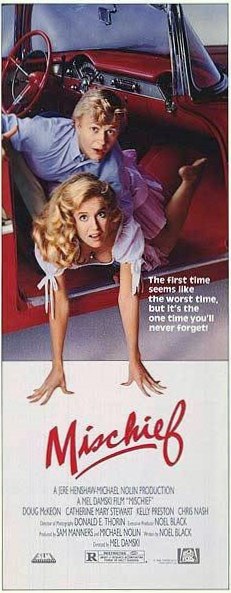
MISCHIEF (1985)


Title: MISCHIEF

Year of Release: 1985

Director: Mel Damski

Genre: Comedy, Drama, Coming of Age

Synopsis: In Nelsonville, Ohio of 1956, Jonathan Bellah pines after Marilyn McCauley, the high school's prettiest girl, but his friend Gene encourages him to pursue her.

Within a film history context: Teenage sex comedies were highly visible on cinema screens in the 1980s. While sex comedies have been present since the beginning of cinema, the 1980s had a large number of teen-oriented films, with varying degrees of quality. The push to bring younger viewers into the cinema, coupled with a new generation of talented performers and personnel, seeking to 'speak' the language of this audience, was the impetus for this genre. One of the first appeared on screen in 1980, being Floyd Mutrux's THE HOLLYWOOD KNIGHTS. It was set in Halloween 1965, with the Hollywood Knights renegade car club members causing havoc in Beverly Hills. The film made money for its creators, and featured a cast of actors latterly famous such as Tony Danza, Michelle Pfeiffer, and Fran Drescher. PRIVATE LESSONS (1981), directed by Alan Myerson, was about a French housekeeper who looks after a businessman's son for the summer, emphasizing sexuality and coming of age themes. It was successful at the box office, which may have been partly attributable to Miss Kristel's reputation from her appearances in the EMMANUELLE erotic comedy franchise. 

One of the most famous, if bawdy teen comedies was the PORKY'S series, beginning with PORKY'S in 1981. Directed by Bob Clark, this first instalment was a hugely profitable movie that spawned two less successful sequels. Its unabashed raunchiness pushed the boundaries of teen sex comedies at the time, and inspired many imitations. 1982 brought the less saucy, but still raucous FAST TIMES AT RIDGEMONT HIGH, directed by Amy Heckerling. With a number of actors in early roles such as Phoebe Cates, Jennifer Jason Leigh, Sean Penn, and Judge Reinhold, it was a blend of comedy and drama, more topical in nature than the other films, but still with teen themes and situations. Further films showcased the teen sex theme in different ways.

Robert J. Rosenthal's ZAPPED! (1982) had a young teenager with telekinetic powers who uses his gift for comical revenge purposes. It was another successful movie which had a later sequel in 1990. One of the most fondly remembered was RISKY BUSINESS (1983), directed by Paul Brickman. More subtle in manner than the all-out films such as PORKY'S, it made a big star of its lead actor, Tom Cruise, apart from grossing a very healthy profit. Nostalgia received another workout in Rafal Zielinski's SCREWBALLS (1983). Set in the 1960s, it was about high school students and their shenanigans. As with the majority of these films, it also was a financial success, if critically shunned. In the manner of PRIVATE LESSONS, MY TUTOR (1983), directed by George Bowers, was another spicy entry in the genre. The story of two young men vying to lose their virginity, with one becoming involved with his alluring French tutor, was a money-making film for Crown Productions. Equally ribald, but in a broader comic manner, was Chuck Vincent's HOLLYWOOD HOT TUBS (1984). Following a young man who works by repairing the hot tubs of the affluent and wealthy in Hollywood, it had a number of funny sequences alongside the more risqué stretches. MISCHIEF had many of the ingredients which were present in the other films such as comedy, nudity and sexual content, but was a much better film for other reasons.

The movie provided characterizations which were deeper than many of the other films previously mentioned. There was more to the characters in MISCHIEF than just pranks and comedic stretches. They had families and subtly sketched relationships not only with each other but also, their parents in some instances. RISKY BUSINESS and FAST TIMES AT RIDGEMONT HIGH were the closest to MISCHIEF in terms of presenting more complex relationships, and situations, that went beyond the superficial themes, and situations, of other movies in the teen genre. MISCHIEF's sexual elements were ribald in keeping with the teen sex comedy theme, but, unlike films such as PORKY'S, they were more about realizations, and coming of age, than just sex for the sake of sex, or titillation. The characters, especially Jonathan and Gene, discuss their feelings about the matter to each other in a candid manner, but there is a psychological frame to this, it is never just about empty talk without some insight into the characters. It is also interesting how once the games are over, and the dust settles on certain relationships, that the characters understand how their actions either assisted, or hindered them in their lives. This more realistic perspective on the characters makes the film more relatable than examples such as PORKY's or HOLLYWOOD HOT TUBS. One of the most intuitive of the teen sex comedies, MISCHIEF is both entertaining but also, a perceptive film experience.

Overview: Mel Damski is a prolific director with a multitude of credits in television, with many telemovies bearing his name, and four motion pictures. His first film, YELLOWBEARD (1983) was a comedy about a man who sought the treasure he had buried many years before, and featured a large cast of comedians including Graham Chapman, Cheech and Chong, Marty Feldman, Madeline Kahn, and John Cleese. Mr Damski's third film, HAPPY TOGETHER (1989) is a comedy romance revolving around a misunderstanding that leads to romance for two characters, one being a writer. His final film thus far, LEGENDARY (2010) was a change of pace for Mr Damki, this being a drama about sport, family and memories. MISCHIEF, Mr Damski's second film, was one of his best achievements.

The screenplay for MISCHIEF was written by Noel Black, and is a strong piece of work. Mr Black is known for films which can sometimes be unconventional in their cinematic treatment, but with MISCHIEF his writing is on target. Mainly comic in nature but with many dramatic moments interspersed, giving the film credence, it is a convincing and smooth film. The script effectively explores many themes such as friendship, first love, loyalty, family, class conflict, and being true to one's self. The direction and pacing of the scenes has a leisurely quality which gives the audience time to get to know the characters and their particular quirks, without events occurring too quickly, which can make some films seem skittish. It is interesting how MISCHIEF shares some similarities to other films in the genre, but how Mr Damski takes these affinities to different places in his film.

MISCHIEF resembles FAST TIMES AT RIDGEMONT HIGH in the set up of its central male friendship. While the other movie had a female friendship at its core, in MISCHIEF Jonathan and Gene feed off each other's lives, this creating a core for the movie. In FAST TIMES AT RIDGEMONT HIGH, Linda, as with Gene for Jonathan in MISCHIEF, is the 'teacher' for Stacy, lecturing her about life, love and sex. Unlike Linda, though, Gene is not a character who does not practice what he preaches entirely. Even though he encourages Jonathan to 'go all the way' with Marilyn, he himself is looking for true love. It is as if he is encouraging Jonathan to 'sow his oats', as he had done, which is a path to finding true love with the right person. In FAST TIMES AT RIDGEMONT HIGH, Linda preaches 'going all the way' but does not do this, instead Stacy taking her words literally. Stacy goes down a path much heavier than Jonathan's, with pre-marital sex causing much anguish. There is a warmth, and mutual understanding between Jonathan and Gene that eclipses Linda and Stacy's more casual friendship. It is an interesting contrast between films, but, in essence, FAST TIMES AT RIDGEMONT HIGH has a seamier atmosphere than MISCHIEF's lighter, more sympathetic tone. While the film possesses these positive qualities, there are certain missing elements which could have provided even more depth to the movie.

The family backgrounds of the characters, in some cases, have been lightly sketched, or not presented at all. The most vivid familial relationship is between Gene and his father in MISCHIEF. This explains much about Gene, and why he acts and reacts as he does. On the other hand, both Bunny and Marilyn's families are depicted very briefly, but it would have been better to have seen more of them. Both Jonathan and Kenny's families, though, are not evident at all in MISCHIEF. As Jonathan is the heart and soul of MISCHIEF, it would have been interesting to have seen both his, and Kenny's family interactions, as these characters were on opposite sides of the spectrum in terms of their behaviour. This, though, also points to another absence in the film that would have made it stronger. Kenny is a wonderfully malevolent character who definitely would have benefitted from more spotlighting. I was waiting to see something more about why he was so wicked but, this never materialized. Rosalie was another character who it would have been a pleasure to have seen more of in MISCHIEF. Jami Gertz's longer, striking appearance in the final scenes was a little too late in coming, but it took the film in an unexpected direction that made perfect sense for the story and characters. Despite these omissions, overall, MISCHIEF is a great film that deserves more acknowledgement as one of the most thoughtful teen sex comedies of the 1980s.

Acting: The performances in MISCHIEF take it far and beyond the usual teen comedies of the era which can at times let down the proceedings. As Jonathan, the main character in the film, Doug McKeon is absolutely flawless. An actor of great range and utterly believable in his role as the lust-struck Jonathan, his work sets the humorous, reflective spirit for the movie. As his best friend Gene, Chris Nash also does a great job as the motorbike riding rebel with more to him than first meets the eye. The part could have been one interpreted with histrionics and overwrought bravado, but Mr Nash dispenses with these, instead playing Gene as a young man with innate sensibility, street smarts, and all-round appeal. Kelly Preston is also very good as the calculating, social-climbing beauty who wraps Jonathan around her little finger for a while, providing the film with one of its two chief, and contrasting, female roles. 

As the sensitive Bunny, Catherine Mary Stewart does excellent work in the movie. The dilemma between pleasing her parents with marriage to the arch but financially stable Kenny, and true love for Gene, is nicely played by the lovely Miss Stewart, with a quiet but emotionally rich performance free of dramatics. In the final performance of note in MISCHIEF, DW Brown is excellent as the nefarious Kenny, with some glints of vulnerability evident. Someone used to getting what he wants and leaving no stone unturned in his wake, Mr Brown provides the film with its villain, but gives the impression that there was a lot more which could have been explored with the vituperative, presentable Kenny.

Soundtrack: The soundtrack of MISCHIEF is nicely flavoured with rock and pop songs of the 1950s, featuring artists such as Elvis Presley and Buddy Holly. The songs have been arranged in a subtle manner whereby the music complements the visuals and what is taking place, without becoming akin to a grating, non-stop cavalcade of songs.

Mise-en-scene: The period atmosphere of 1956 Nelsonville, Ohio is excellently evoked by the outdoor locations, and interior production design. It feels as if the viewer is actually taking a trip back to another time, and place, in the world. The colour cinematography by Donald E. Thorin is beautifully utilized in the film without ever becoming garish, never intruding on the action. Costuming is also first-rate, suitable in keeping with the personalities of the characters and appropriate for the actors.

Award-worthy performances in my opinion: Doug McKeon, Chris Nash, Kelly Preston, Catherine Mary Stewart, DW Brown.

Suitability for young viewers: No. Frequent coarse language, male nudity, female nudity, adult themes, low-level violence.

Overall Grade: B

LinkIMDB Page

Trailer