Showing posts with label Australian film. Show all posts

Monday, August 7, 2023

THE SET (1970)

Title: THE SET

Year of Release: 1970

Director: Frank Brittain

Genre: Drama

Synopsis: An aspiring designer becomes part of the Sydney art society set.

Within a film history context
Homosexuality in motion pictures was not a common occurrence before the breakdown of film censorship in the late 1960s. There were, though, examples of subtly drawn gay characters and themes in films before THE SET. One of the first documented movies in this vein was Sidney Drew's A FLORIDA ENCHANTMENT (1914). In this film, a man and a woman undergo transformations into a gay man and a lesbian via the effect of seeds. It was one of the earliest films to examine gay sexuality in motion pictures, albeit in a comical manner. The love affair of two male musicians was explored in the German film DIFFERENT FROM THE OTHERS (1919), directed by Richard Oswald. Blackmail comes to the fore in this movie, with true love thwarted by a scheming man seeking to make the lovers pay for their forbidden love, with famous German actor Conrad Veidt in the lead as one of the harried musicians. In comparison, another German film, Carl Theodor Dreyer's MICHAEL (1924), spotlighted a gay painter's lover for his male model, and the difficulties their union faced. 

Into the 1930s and 1940s, gay characters were most likely to be presented in a comic manner, unlike the other examples here mentioned, and in supporting roles. Notable divergences from this were found in Pre-Code 1930s American movies such as SUNNY SKIES (1930), directed by Norman Taurog, with a gay romance story, and Raoul Walsh's SAILOR'S LUCK (1933), which also had a gay character. Of the 1940s movies ROPE (1948), directed by Alfred Hitchcock, featured a murderous gay couple, but in line with the censorship of the period, this was very much inferred with delicacy. Moving into the 1950s, there were several intimations of gay characters slightly more open in nature than those of beforehand, with some that definitely pushed the boundaries.

Possibly the most explicit gay themed film of its era, although a short movie, was Jean Genet's A SONG OF LOVE (1950). Set in a jail with prisoners and a guard among its characters, it concentrated upon sexuality, glimpses of nudity, and fantasy in a manner that was a first for its time. Another French film, the full-length THE TERRIBLE CHILDREN (1950), directed by Jean-Pierre Melville, contained a gay character, played by a female actress in a dual role, in a more conventional narrative of heterosexual romance with some homosexual undertones. With Vincente Minnelli's TEA AND SYMPATHY (1956), matters were entirely different. A thoughtful young man is believed to be gay, everyone attempting to change him, but finding sympathy with the wife of his coach. A bowdlerized film version of the stage play, it nonetheless treated its main character with empathy, despite references to homosexuality being discreet. SUDDENLY LAST SUMMER (1959), directed by Joseph Mankiewicz, was much more open about its gay character. Although the character's face is never shown, the impact of his presence in the movie is what propels the narrative, and his death is what drives his cousin, played by Elizabeth Taylor, to mental illness. Segueing into the 1960s, a gradual loosening of the Production Code brought forth franker films with more openly gay protagonists.

In Gregory Ratoff's British OSCAR WILDE (1960), the film followed the famous writer's legal trials and travails with his homosexuality, with Robert Morley in the lead role. Another British picture, A TASTE OF HONEY (1961), directed by Tony Richardson, featured a gay character in this realistic study of a young woman, and her family issues. A more devastating view of gay life and discrimination was presented in Basil Dearden's VICTIM (1961). The taut tale of a married barrister undone by a past gay affair, and involvement with blackmailers, showcased Dirk Bogarde in one of his finest performances. ADVISE AND CONSENT (1962), directed by Otto Preminger, was similar to VICTIM in that the main character's past homosexuality comes back to haunt him, but this time, running for Secretary of State in the United States government. Bryan Forbes' THE L-SHAPED ROOM (1962), had a minor gay character within its structure, in this case a musician. A more in-depth examination of homosexuality was in TAKE IT ALL (1963), directed by, and starring Claude Jutra. In this movie, a man's difficulty in coming to terms with his sexual orientation, and relationship with a black woman, made up the content of this picture. Sidney J. Furie's THE LEATHER BOYS (1964), had a gay motorbike rider in its canvas, with a scene in a gay bar also shown. BUS RILEY'S BACK IN TOWN (1965), directed by Harvey Hart, also offered a minor character of the gay mortician who wants to offer more than employment to lead protagonist Bus. Into the mid-1960s, John Schlesinger's DARLING (1965), had a gay photographer in a small part, common for many films of the era to have a homosexual character in a supporting role. 

INSIDE DAISY CLOVER (1965), directed by Robert Mulligan, was an expose of Hollywood, and starred Robert Redford as a man with a shadowy gay sexual orientation. The controversy surrounding this did not help the film at the box office, where it was not a success. More explicit was Andy Warhol and Chuck Wein's MY HUSTLER (1965). The story of an older hustler pursuing a younger one, it was one of Andy Warhol's many gay-themed films to reach audiences in the 1960s. Much more subtle in tone was WINTER KEPT UP WARM (1965), directed by David Secter. The friendship between two young university students, and their complex feelings for each other, was tackled by the director in this intricate movie. Jean-Claude Lord's DELIVER US FROM EVIL (1966), also had a storyline rooted in human emotion, with gay desire and bisexuality being the burning topics. In addition, John Huston's REFLECTIONS IN A GOLDEN EYE (1967), also treated its subject with candor, being an army colonel whose interest in an army private causes him to commit murder. 

A western theme was the basis for LONESOME COWBOYS (1968), directed by Andy Warhol. Featuring five gay cowboys provoking mayhem and indulging in sexual exploits, it was another in the director's unconventional works. In marked contrast, a tense mood thoroughly enveloped John Flynn's THE SERGEANT (1968). The story of an army sergeant, and his passion for a private, was studied in much greater detail than in the related REFLECTIONS OF A GOLDEN EYE, and provided Rod Steiger an excellent role as the eponymous sergeant, with John Phillip Law as the object of his obsession. A complex view of homosexuality was also captured in TEORAMA (1968), directed by Pier Paolo Pasolini. An Italian family receives a visitor at their home, who changes their lives, male and female, both sexually and otherwise. A different perspective on sexual relations, it was one of the director's most intimate, challenging works. 

Bryan Forbes' DEADFALL (1968), had a treacherous gay character whose actions influenced much of the goings-on in the movie with his dishonest ways. FLESH (1968), directed by Paul Morrissey, was another of Andy Warhol's movies with gay overtones. This time around, a male prostitute services both men, and women among his shenanigans. Guilt about homosexuality, and its aftermath, was played out in Gordon Douglas' THE DETECTIVE (1968). An incisive portrait of a police detective searching for the killer of a man believed to been gay, it was an excellent showcase for Frank Sinatra in the lead role of the undaunted investigator. MIDNIGHT COWBOY (1969), directed by John Schlesinger, was similar to FLESH in that its male character was an escort, but diverges from that film in the sympathetic treatment of its lead protagonist. He comes into contact with several gay men in the course of his escorting, but this is treated in a more serious fashion than the casual FLESH, where there are no tragic consequences for that character. Luchino Visconti's THE DAMNED (1969), was of a darker nature than the other examples. Homosexual activity in this movie is depicted as being depraved, and its participants likewise, with its Nazi-era German setting. 

FELLINI'S SATYRICON (1969), directed by Federico Fellini, featured a male-male gay couple, and some related entanglements, in this raucous story set in ancient Rome. In a comical style was Bruce Kessler's THE GAY DECEIVERS (1969). Two young men act as gay to avoid being drafted to the Army, but their decision entails difficulties of its own, especially as they attempt to keep their heterosexual lives on the side. An intentionally comical take on the gay theme, it was notable for also having serious undertones. HUNTING SCENES FROM BAVARIA (1969), a German film directed by Peter Fleishmann, was concerned with a man's sexual orientation, and how this causes problems in the Bavarian village in which he resides. An antithetical, overtly humorous, if broad, movie was Stanley Donen's THE STAIRCASE (1969). The tale of two older gay men who operate a barber shop, it was not well received critically, despite starring Rex Harrison and Richard Burton as the central duo. THE SET was notable in that it contained gay characters and themes, allowed by the breakdown of Australian film censorship at the time, but, overall, was nonsensical in its treatment of these.

THE SET was a two-pronged attempt at looking at homosexuality, both in a serious manner, but also, with some lighter moments. It had more in common with the irreverent films on the topic, such as A FLORIDA ENCHANTMENT, and THE GAY DECEIVERS, with their outrageous characters, THE SET also sporting several over-the-top gay characters, and a cross-dressing burlesque performer. On the same count, it also attempted to present a somewhat more subdued view of homosexuality, and its attendant desire, in the person of its main protagonist, Paul Lawrence. Paul is shown as turning to a man, Tony Brown, in light of his professional troubles, which is something the other movies of its type did not deal. There did not appear to be any pre-existing desire for a man present, but when the physical relationship eventuates, there is a sense of guilt, with Paul playing with the cross around his neck. There is a subtle religious background to this that the movie, though, does not actively pursue. The leads to other sentiments that the movie seeks to express.

It is as if the film wishes to posit that Paul's flirtation with homosexuality was an aberration on his part, and experimenting something that only affirmed his heterosexuality, thus leading to his return to girlfriend Cara. The use of Tony was also interesting, as he was bisexual, not only being with women but also, men, namely, Paul. Tony's effort to out Paul as gay to Cara at the party fails miserably, and was one of the pithiest scenes in the movie, taking things in an unexpected direction. Tony in THE SET, in effect, is one of the most duplicitous gay characters ever on film. Trying to trap another man in the web of homosexuality, while acting heterosexual all the while, made him a psychologically complex character, harking back to villains from DIFFERENT FROM THE OTHERS and ROPE. It appears, though, that there is a discomfort on Tony's part with his gay side, reflected in his shows of bravado, and hypermasculinity. Tony is another version of those who attempted to make a gay barrister's life miserable in VICTIM, but, for Paul in THE SET, events conspire for him to not be punished for his past homosexual activities. An interesting, and different, look at homosexuality, THE SET fits fits well with its uncommon spin on the topic. 

Overview: Frank Brittain was an Australian director of mainly short documentaries, with several credits as producer and writer. As THE SET is Mr Brittain's sole movie as director, this review will focus upon his contribution to the film. With THE SET, Frank Brittain has fashioned an entertaining, fast-moving motion picture. Concentrating upon a young man, and his experiences in the Sydney art scene, with his rise, and personal difficulties charted here, it is a watchable movie. The film succeeds in examining the art scene, the various personalities who populate this world, and their many liaisons. It also contrasts two young men, one being Paul Lawrence, an aspirant to the art world, the other being Tony Brown. This is where the movie examines homosexuality through these characters, specifically, Paul's latent feelings in this regard, and Tony's raw bisexuality. THE SET also has other gay characters who pop in and out of the narrative, but Paul and Tony are the main focus. While the movie does look at homosexuality as a main part of its scope, it is, in the main, handled with an air of flippancy, symptomatic of the film as a whole.

On the one hand, it is to the film's advantage that the pace is rapid, and does not let up, but this also has the effect of making story events run too fast through the film, rendering it emotionless at times. Paul's relationship with Marie Rosefield is there for a few moments, then gone in quick succession. There is no real impact on Paul of her death, as it is very fleeting. Tony's affairs with both Kim, and her mother Peggy, are similarly blasé. Kim's feelings about Tony, and discovery of his affair with her mother are well-handled, but the reason for the married Peggy's dalliance with Tony is given, but not backed up in a way to make one feel for Peggy. It is just a case of a bored, middle-aged woman having an affair with a younger man. Paul's brush with homosexuality, with John and Tony, are also handled in a listless manner. It seems as if the film wishes to say that Paul's homosexual tendencies are something temporary, and that true love is with Cara, which would raise the ire of certain viewers with this particular plot point. 

Peggy's affair with Mark has to be, by far, the silliest plot point in the movie. It does nothing but further the fact that Peggy is a promiscuous woman, which makes the character very shallow indeed. It does not delve into her psyche in a constructive way, but is just an exercise in visual thrills. The majority of relationships in the movie fall into this category, being akin to bedhopping without any real rationale for these. This, though, is an example of what THE SET, in essence, is about. It appears that it was not intended to be a deep exploration of these characters, rather, a superficial account of people, with an eye on amusement for viewers. It is a shame as it could have been a much better movie, if it had more real passion, but as it is, THE SET is a mindless diversion for undemanding viewers.

Acting: A number of acting performances assist THE SET in its watchability, despite its many flights of fancy. In the lead role of designer Paul, Sean Myers is striking. A good-looking actor with an otherworldly presence, who would have been at home as a hero in Jane Austen novel, here gives a thoughtful rendition of a young man finding himself in a somewhat prickly world. The complex, charismatic Tony Brown is made memorable by Rod Mullinar. A man of many moods and inclinations, Mr Mullinar succeeds in presenting a person who would do, and any say anything to get what he wants from those around him, but with some touches of sensitivity which surprise at the most unexpected moments. Denis Doonan, as Mark Bronoski, is one of THE SET's most distinctive characters. With his moustache, flamboyant ways, and penchant for physical comedy, Mr Doonan's appearance is one of the movie's comic highlights. The final performance of note was by Brenda Senders as poised designer Marie Rosefield, Paul's short-time flame. Running the gamut from calm, to despair, to sadness in her final scenes, Miss Senders' impact in the picture is keenly felt, if, unfortunately, all too brief in duration.

Soundtrack: Sven Libaek's music in THE SET sets an appropriate tone for the movie. The use of the song 'Start Growing Up Now', performed by the Flanagans, is a subtle comment upon the main character, and his experiences in the movie. It is utilized in both the opening credits, and the closing scene. Aside from this, there are incidental music pieces which have impact in the movie, such as the scene where Paul fondles Tony. The segment where Tony plays football with the children in the street is also notable, with its piano, flute, and harmonica strains adding a depth, and solemness to the scene. 

Mise-en-scene: THE SET has an excellent grasp of mise-en-scene, which is to the advantage of viewers. The black and white cinematography by Sandor Siro is beautiful, giving the movie an artistic and polished look, in keeping with its European art house feel. Art direction by David Furley effectively creates a story world that is plausible and realistic. Many examples abound in THE SET of this. The home Peggy inhabits with her husband is up to the minute in furnishings and accessories of the era, befitting their high socioeconomic position. Tony's home is more of a stark labyrinthine abode which is in keeping with his volatile, deceptive personality. The opening sequence is also striking, with images taking up one half of the screen, the other containing the cast and crew credits. There is the implication that the movie will deal with erotic themes and nudity, the sequence effectively telegraphing this to the spectator.

Notable Acting Performances: Sean Myers, Rod Mullinar, Denis Doonan, Brenda Senders.

Suitability for young viewers: No. Male nudity, female nudity, adult themes.

Overall GradeC

LinkIMDB Page

Saturday, July 1, 2023

STONE (1974)

Title: STONE

Year of Release: 1974

Director: Sandy Harbutt

Genre: Drama, Action, Adventure

Synopsis: A policeman investigates the murders of biker gang members which might be linked to the witnessing of a political assassination.

Within a film history contextFilms about outlaw motorcycle gangs were at their height during the 1960s and afterwards, but there were several examples of these on screen from the 1950s. They are also of interest for the sheer variety of themes which they tackle. The first major film about bikers, THE WILD ONE (1953), directed by Laslo Benedek, starred Marlon Brando in one of his signature roles. In this movie, two motorcycle gangs go head-to-head, and when one of their leaders is placed in jail, take out their anger on a small town. Interesting to note that this was made by a major Hollywood studio, Columbia Pictures, and seminal at the time for its view of events. Later films were made by smaller studios, with lesser-known actors and directors. In Edward L. Cahn's MOTORCYCLE GANG (1956), a biker rails against being part of a more legitimate motorcycle club, his actions causing trouble with the other members. In a similar exploitation vein, DRAGSTRIP RIOT (1958), directed by David Bradley, a young man and his girlfriend are thought to have killed a biker from a gang, with the gang's other members seeking revenge, but the crime was committed by someone else. The mid to late 1960s brought forth a plethora of biker gang themed movies to film audiences.

Director Russ Meyer heralded a more violent brand of biker movie with MOTORPSYCHO! (1965). With this film, revenge was the order of the day, as a man whose wife was raped by bikers, and a woman whose husband was killed by the same bikers, unite to seek retaliation on this gang. In 1966, Roger Corman's THE WILD ANGELS was released. Starring Peter Fonda who would later appear as a biker in EASY RIDER (1969), it was about a San Pedro motorcycle gang creating fracas in California. Another notable entry was THE BORN LOSERS (1967). Both directed and starring Tom Laughlin, it followed a young man who takes on a motorcycle gang at their own game. It spawned four sequels over time, and was a major box-office success. Richard Rush's HELLS ANGELS ON WHEELS (1967), followed a gas station attendant who aspired to join a biker gang, but really living life as a biker is not something for which he is entirely prepared. THE GLORY STOMPERS (1967), directed by Anthony M. Lanza, concentrated on a war which erupts between two rival gangs when the leader of one physically assaults the other, and he is believed dead. They kidnap the leader's girlfriend, but he is alive, and prepares to rescue her.  

Somewhat different in nature from previous films was Herschell Gordon Lewis' SHE-DEVILS ON WHEELS (1968). In this instance, a female motorcycle gang causes problems in a small town, par for the course for many films in the genre, and also, take on a male biker gang. In a similar vein, THE MINI-SKIRT MOB (1968), directed by Maury Dexter, also had a female biker gang as the focus. This time around, the leader of an outlaw female biker gang is inflamed that her ex-lover has married, and plots revenge against the couple. Life, though, does not make retaliation easy in this American International Picture. Richard Rush's THE SAVAGE SEVEN (1968), was of a related theme. The romance of an outlaw biker with a young waitress is challenged by her disapproving brother, who is the leader of an American Indian community. In contrast, exploitation movie SISTERS IN LEATHER (1969), directed by Zoltan G. Spencer, had a lesbian biker gang at its center. When this gang witnesses a man having an affair with another woman, they befriend his wife to groom her as a gang member. The husband, though, enlists the assistance of some male bikers to rescue his wife from the lesbian gang. Jack Starrett's RUN, ANGEL, BABY! (1969), was of another persuasion. When a biker writes an article about his gang for a magazine, it angers the members, causing him and his girlfriend to flee as he is now a hunted man. 

Into the 1970s, THE GIRLS FROM THUNDER STRIP (1970), directed by David L. Hewitt, took things in another direction for an outlaw biker movie. A sadistic biker gang meet their match in three young women, both competing in the arena of bootlegging, Different in scope was Jack Starrett's THE LOSERS (1970). Instead of being set in the United States, the movie has members of a biker gang sent to the Vietnam War to fight, and in turn find and rescue a CIA agent. One of the most irreverent biker movies was C.C. & COMPANY (1970), directed by Seymour Robbie. The power play between two bikers for hierarchy envelops a biker gang, and drags a journalist into the picture, in this entertaining movie. With Joe Viola's ANGELS HARD AS THEY COME (1971), issues begin when a biker is murdered, and this event pits two biker gangs against each other, as one blames the other for this incident. For something left of center, J.C. (1972), directed by William McGaha, offered a biker gang more benign than most of its violence-fueled counterparts. A man joins a biker gang, and believes that he is the coming of Jesus Christ, his family background responsible for this, but comes unstuck with his actions as a biker. STONE was one of the later films about an outlaw biker gang, and one of the most captivating.

It had the same great scenes of motorcycle action which marked all the films in the genre, most notably examples such as THE WILD ONE, THE WILD ANGELS, THE GLORY STOMPERS, and C.C & COMPANY, to name just some. These visually arresting sequences were where the movies were at their most exciting, and usually accompanied by a thumping rock soundtrack, which gave the impression of freedom, and lack of inhibitions of the bikers. Another interesting facet was the presence of female members of the outlaw gang in STONE, something also shared by C.C & COMPANY. While in C.C & COMPANY the female characters did not serve a great purpose, other than that of comedy routine or sex object, in STONE they are allowed to exhibit more emotion. The open grief of a female biker at the funeral of a male gang member is one of STONE's best moments. STONE does, as with C.C & COMPANY, exhibit its female characters in a state of undress, but in STONE they have a stronger position within the gang than just being floozies. 

Something else which distinguishes STONE is the sense of anger, and displacement from society which the gang members feel. Finding kindred spirits in this form gives the movie a point of difference, in that the members are not rebels without a cause, or psychotic war veterans, something which has been overused as a device in MOTORPSYCHO!, and other examples. Their ire is raw and palpable, and there appears to be more to it than just going against the confines of society. In addition, the presence of policeman Stone himself within the narrative is another original move. Generally, the police bring law and order back after the biker gang has passed through a town, and wreaked havoc. They are seen in a negative light, as in STONE, but Stone becomes part of the biker gang's lives in order to find out who is killing its members. The film's ending, though, does return the characters to how they were before Stone became a part of their orbit, making sense for the story, and its protagonists. A fresh take on outlaw biker gangs, STONE is an enjoyable movie.
 
Overview: Sandy Harbutt was an Australian director who made only one motion picture, being STONE. He acted in many Australian prime time television series in the late 1960s and early 1970s, two telemovies, and several films such as COLOR ME DEAD, SQUEEZE A FLOWER, and STONE. Aside from acting in the film, Mr Harbutt was responsible for the screenplay, production, music, and production design of STONE. As the picture was his only directorial credit, the overview will concentrate upon his contributions to STONE.

With STONE, Sandy Harbutt has created an original motion picture. It follows a group of bikers who unwittingly become embroiled in a political assassination, with some of their members executed as a consequence. The police assign Stone, a young, bohemian undercover officer to join the gang, and subsequently stop the murders. With his observant and sympathetic eye cast on STONE, Mr Harbutt succeeds in making the biker gang members human, and their feelings palpable to the audience, instead of falling into the habit of having them go crazy just for the sake of spectacle. They are gang members for the reason that they do not fit into societal norms of appearance and behavior, banding together as they share common beliefs and value systems. Their anger at being seen as animals is keenly felt, particularly during the funeral scene, with Toad's verbal exchange with police officers one of the best instances. There is an undercurrent of sadness which permeates the movie, being how people in life are sometimes given no choice, and resort to being on the fringes of society to survive in light of their being different from others. While STONE contains many thoughtful moments, there are flaws which do hinder the film.

STONE begins in a spectacular fashion with the killing of a politician in a public area, which is visually compelling. The murders of two biker members are also handled in the same surprising manner, which leads the viewer to believe that payback will occur later in the movie. The threads of political intrigue and murder, though, are never properly addressed, leading to a feeling of inconsistency in the picture. These plot points run through the film but both tantalize, and disappoint in the final summation. The proper addressing of these in the narrative would have added another dimension to STONE, and explained some enigmas. The red herrings in this respect are a letdown, though this may have been intentional. Looking at the film as a whole, the concentration upon the lives of the gang members, and how Stone becomes more and more involved with them, is where STONE is at its best. One of the best movies about outlaw bikers, STONE is an entrancing motion picture.

Acting: STONE has several stimulating acting contributions. In the lead role of policeman Stone, Ken Shorter is appropriately low-key, deftly balancing the sometimes outlandish biker antics displayed by the movie with his underplaying. As Stone's girlfriend Amanda, Helen Morse shows why she is one of Australia's best actresses. With her subtle expressions, particularly the use of her eyes and face to relay various emotions, Miss Morse is perfect. The leader of the biker gang, Undertaker, is given strength by Sandy Harbutt. Aside from directing and other duties, Mr Harbutt is fine as the raw, no-nonsense biker. As the flamboyant, theatrical Toad, Hugh Keays-Byrne is memorable. A performer with a unique look and manner, his Toad is a fully-fleshed character, making his over the top behavior real within the context of the film. The last acting of note was by Drew Forsythe as Fred, a young man who visits the bar with the bikers in attendance, and gets more than he bargained for. Mr Forsythe is a familiar face on film and television, and here makes an indelible impact with his precise, restrained performance as the man who is definitely out of his element with the biker gang. 

Soundtrack: STONE has an eclectic soundtrack by Billy Green which is mostly rock music-oriented in nature. This is suitable as the film deals with bikers, and their rough and tumble world. There is, though, one main exception to this which works in a surprising manner. The skinny-dipping scene is accompanied by a classical style tune which works to infer that the nudity portrayed is cathartic, rather than perverted in its presentation. 

Mise-en-scene: There is no doubt that STONE offers a stimulating visual experience for viewers. Cinematography by Graham Lind is excellent, with Eastmancolor stock employed in an appropriate use of color. The color is natural, and suited to a picture about bikers and their exploits. Mr Lind also captures the copious outdoor location sequences with grace, and interiors with the same adeptness. Interiors in many instances are dark, with little light, but actors are well-illuminated for the audience to see. There are also nice contrasts drawn between the two worlds the film delineates. The ramshackle, grungy world of the bikers, is contrasted with the more serene, upmarket existence of Stone's girlfriend Amanda in a telling segment.

Another interesting aspect is the overhead photography, and fuzzy camerawork at the beginning of the film, which is fresh and innovative. Aside from this, art direction by Tim Storrier is also pivotal to the film's success. Sets such as Stone's home, with its assortment of homewares, the bar the bikers visit, and the nightclub Stone conducts an investigation, are all realistic, plausible locations which speak of the characters in non-verbal sense. Costuming is another great area in the film. The work here by Helen Morse and Margaret Ure is at its best in the costumes of the bikers, and the ability to individualize characters in terms of their dress. 

Award-worthy performances in my opinion: Ken Shorter, Helen Morse, Sandy Harbutt, Hugh Keays-Byrne, Drew Forsythe.

Suitability for young viewers: No. Infrequent coarse language, male nudity, female nudity, adult themes, drug use, high-level violence.

Overall Grade: B

LinkIMDB Page

Saturday, April 1, 2023

DIMBOOLA (1979)

Title: DIMBOOLA

Year of Release: 1979

Director: John Duigan

Genre: Comedy

Synopsis: Life in an Australian country town, with preparations for the wedding of two of its townfolk.

Within a film history context: Ocker comedies began to appear on Australian cinema screens from the early 1970s. In general, these spotlighted a male character, the eponymous 'ocker' who indulged in uncouth behaviour ranging from excessive drinking, sexual antics, swearing, and sexist attitudes toward the opposite sex. The first film in this genre was Tim Burstall's STORK (1971). The story of a gangly man and his outré activities, specifically with women, was a box office success of its time, and initiated the ocker genre to cinema. THE ADVENTURES OF BARRY MCKENZIE (1972), directed by Bruce Beresford, was another movie that made money. A man goes to Britan with his aunt to claim an inheritance, and a clash of cultures between Australian, and British sensibilities ensues in this comedy. The movie was so popular that a sequel, BARRY MACKENZIE HOLDS HIS OWN, was released in 1974, also directed by Bruce Beresford. 

A less humorous entry in the cycle was Tim Burstall's PETERSEN (1974). A rough and tumble electrician goes to university to further himself in life, but finds that he is instead drawn to sex escapades and affairs, unable to stay away from the lewder aspects of life. More satirical about its milieu and characters was DON'S PARTY (1976), directed by Bruce Beresford. The activities of characters on election night in 1969 Australia are placed under the microscope, letting everything hang out in their lives in both literal, and figurative senses. One of the final ocker movies of the 1970s, Tom Jeffrey's THE ODD ANGRY SHOT (1979), this time was set during the Vietnam War, following the hijinks of Australian soldiers on their tour of duty. DIMBOOLA was also released in 1979, but was another take on the ocker comedy.

It shared the focus on a male character, and his personal relationships, especially with women, which the other ocker films also highlighted within their individual contexts. In the case of DIMBOOLA, though, Morrie is found in a compromising situation with a stripper before his wedding, which sets in motion the breakup of his engagement. He is shown to not be comfortable placed in this position, unlike the characters of STORK, PETERSEN, and DON'S PARTY, where they were anything but unwilling in this respect. Aside from this, DIMBOOLA also had a multi-character structure, similar to DON'S PARTY, where events are deciphered through the eyes of many diverse protagonists. This allows for multiple viewpoints to be examined by the audience, although DON'S PARTY did a much more effective job due to its sturdier narrative.

Another area where DIMBOOLA diverts is in its setting. STORK, PETERSEN, and DON'S PARTY were in predominant urban/suburban settings, while THE ADVENTURES OF BARRY MCKENZIE, and its sequel, were largely set in England. DIMBOOLA was set in a country town, and afforded a completely different visual background for its characters, and consequently, for the viewer than the other movies. Lush outdoor locations, a country town with its homes, streetscapes, stores, cinema and theatre was the best, most expressive feature of the movie. The visual beauty of DIMBOOLA somewhat balanced its top-heavy storyline which too often strayed into over the top, exaggerated moments. An interesting sojourn into ocker film territory, DIMBOOLA is another perspective on this film genre.

Overview: John Duigan is an Australian director who has made twenty-one films over the course of thirty-seven years. His movies are thoughtful, character-driven narratives, many of these set in past eras, or with rural backgrounds. THE FIRM MAN (1975), marked Mr Duigan's debut. It was the story of a businessman starting work at a new company, his personal life, and friendship with a younger woman which takes things into another direction for him. THE TRESPASSERS (1976), similarly dealt with a male character and his personal troubles, this time following a journalist living with a woman. He has an affair with another woman, and the meeting of both of these women in his life takes a surprising turn. MOUTH TO MOUTH (1978), was the study of four young people battling to survive in the big city, documenting their hardships in detail. Into the 1980s, John Duigan made a number of meaningful films.

WINTER OF OUR DREAMS (1981), was about a man who hears of the suicide of a former girlfriend, and how he tries to discover more about this and becomes involved with her friend, a prostitute. This was John Duigan's first commercially successful movie, with Bryan Brown and Judy Davis in the lead roles. In FAR EAST (1982), a woman, whose journalist husband has been kidnapped, seeks help from a former lover, played by Bryan Brown, to save him from the Filipino military junta. Much more comical in orientation was ONE NIGHT STAND (1984). Four teens are trapped inside the Sydney Opera House, with nuclear war breaking loose worldwide, causing them to behave in a weird way, with Sydney possibly in the midst of an attack. It was back to more meditative fare for Mr Duigan with THE YEAR MY VOICE BROKE (1987). Charting the fractured relationship between a young man and woman in 1960s Australia, it won five Australian Film Institute awards, and made a star of its lead actor Noah Taylor. John Duigan rounded out the decade with ROMERO (1989), his first American film. A biopic of Salvadoran Archbishop Oscar Romero during the tumultuous era of a tyrannical regime in El Salvador, it was critically well-received, but a loss maker financially. 

It was back to Australian movies for John Duigan with FLIRTING (1991). In this sequel to THE YEAR MY VOICE BROKE, the character from the first film is now in boarding school, and falls for a young woman in an all-girls boarding school. Their union is threatened by issues of race, as the young woman is Ugandan-Kenyan-English. WIDE SARGASSO SEA (1993) was a period piece set in 1840s England. A young woman inherits land in Jamaica, on the proviso that she marries, but this marriage is filled with nothing but heartache for her, and her husband. SIRENS (1994), was set in 1930s Australia, charting the scandalous activities of artist Norman Lindsay, famed for his portraits of naked women. It was another success for John Duigan, grossing a handsome profit at the box office. 

John Duigan made his next American film, THE JOURNEY OF AUGUST, in 1995. The tale of a farmer in North Carolina of 1815, and his friendship with a female slave, it was an ambitious project which received miniscule box office. THE LEADING MAN (1996), was another letdown financially. A playwright initiates a complex chain of events to continue his affair with his actress-lover, trying to save his wife by seeking a lover for her, but things do not go the way he initially intended. LAWN DOGS (1997), was about a young pre-teen girl in a new gated community, and how her friendship with a gardener raises many questions about the nature of this relationship. In contrast, MOLLY (1999), was a comedy. A bachelor businessman takes on the care of his autistic sister, and she has surgery to improve her health, but things do not go to plan for Molly, or her brother. Into the 2000s and beyond, John Duigan made several more movies.

There was a foray into thrillers for Mr Duigan with PARANOID (2000). A young fashion model attends a party where she is left on her own, and undergoes many painful and humiliating experiences. It was back to comedy with THE PAROLE OFFICER (2001). A parole officer is set up for a murder charge, and finds that his former clients are the only ones who can help him out of this scrape. HEAD IN THE CLOUDS (2004), was another of John Duigan's period pieces. In this film, spanning from the 1920s, until the late 1930s in Europe, the lives of several young people are intertwined by love, and the flaming political atmosphere of the time. Unfortunately, it was another box office failure for the director, receiving acidic reviews. John Duigan's last picture to date, CARELESS LOVE (2012), centered upon a university student who works as a prostitute on the side, and becomes involved with one of her clients. Her life takes a turn for the worse after she falls for a fellow student, both of these relationships tested to the nth degree. As John Duigan's fourth movie, DIMBOOLA was one of his least successful projects.

In the case of DIMBOOLA, regrettably, the director has made an uneven motion picture. Set in the small real-life Australian town of the same name, it is based upon a 1969 play by John Hibberd. It follows the exploits of the town's residents, particularly focusing upon preparations for a wedding. DIMBOOLA also has a subplot about a British journalist who is in town to cover the wedding, and his involvements with the various citizens. While the director is adept at showing local colour, which is one of the movie's best qualities, the story is haphazard and overdone. There are too many characters in the picture, and it is difficult to keep up with all their adventures. In attempting to give as many characters as possible a chance to be seen in the film, it ends up being overloaded. DIMBOOLA did not require as many players as it had, and should have concentrated upon one main story thread. Morrie and Maureen's backwards and forwards engagement, complete with complications, is largely relegated to the back burner with the movie's avalanche of people, and their wacky ways, taking up space in the narrative. These consume valuable time that could have been better served with less people everywhere. Aside from this, there are some other tendencies which do not work in favor of the movie.

One would believe that having a British journalist covering the wedding would be beneficial to DIMBOOLA, giving it a sense of place, and perspective akin to a Greek chorus, but it never quite comes off as it should. Vivian Worcester-Jones, instead, seems to breeze into the movie, and out of it in the end. His only purpose is to comment lightly upon the happenings in the town, but the usefulness of the character is negligible. If he never appeared in the film, he would not have been missed. In addition, the movie likes to present cameos which is a positive thing, but having a host of characters pass through renders it top-heavy. The effect is that one does not have time to get to know these people, which points to something else in DIMBOOLA. The lack of real emotion felt for the characters, and what they go through, makes DIMBOOLA a dispiriting experience. The periodic vulgarity, and broad humor, results in many characters feeling more as caricatures than real people. Morrie's paternity should have been a stronger point in the film, but it is handled so flippantly one wishes things had been otherwise. DIMBOOLA seems to have been assembled just to see how outrageous one could be in the film, but without the spirit of real passion. One of John Duigan's most disappointing movies, DIMBOOLA makes one yearn for what could have been if it had firmer direction.

Acting: There are several performances which stand out in DIMBOOLA. As Morrie McAdam, Bruce Spence is in one of his best roles. A unique actor with a likeable presence, he does excellent work as the often-confused, put-upon Morrie. Morrie's other half, Maureen, is nicely played by Natalie Bate. With her forthright, well-spoken outlook, Miss Bate is a great foil for Morrie, and his lost-for-words persona. Unfortunately, Max Gillies, as Vivian Worcester-Jones, is not in one of his best parts. One of Australia's foremost comedians and impressionists tries hard to bring whimsy to his role, but is let down by the writing of the character. On the other hand, Bill Garner, as the ultra-masculine Dangles, Morrie's friend, is delightful. Seeing Dangles' masculinity satirized is one of DIMBOOLA's best moments, but Mr Garner ensures that Dangles has some vulnerable edges which make him real. 

Soundtrack: DIMBOOLA's use of sound is one of the things which works in its favor. Orchestral music is utilized both at the film's beginning, and end. In the first instance, it is diegetic, with the band playing in the town streets. The second time the piece is played is during the closing credits in a non-diegetic sense. The film otherwise has isolated instances of music, some diegetic, such as the band playing at the wedding, with non-diegetic music in scenes such as the evening after the buck's party, with Morrie laying on the ground, face covered in mud.

Mise-en-scene: One of DIMBOOLA's best aspects is its attention to detail in the visual experience for viewers. Tom Cowan's carefully composed cinematography is beautiful, making the locales in the country town lush to the eyes. His work on the interiors, such as Morrie and Maureen's wedding party, is likewise astute, evoking memories of Twentieth Century Fox studios' Technicolor extravaganzas with their appealing use of color. Production design by Laurence Eastwood, and Anni Browning's set decoration, are also pluses, creating a story world, and a country town which is vivid to witness, despite the film's wayward story. 

Notable Acting Performances: Bruce Spence, Natalie Bate, Bill Garner.

Suitability for young viewers: No. Infrequent coarse language, male nudity, female nudity, adult themes.

Overall Grade: D

LinkIMDB Page

Saturday, December 10, 2022

THE GREAT MACARTHY (1975)

Title: THE GREAT MACARTHY

Year of Release: 1975

Director: David Baker

Genre: Comedy, Sport

Synopsis: A rising young football player is recruited by force for the South Melbourne Football Club, and becomes involved with many colorful characters in his journey.

Within a film history context: Movies about Australian Rules Football actually appeared after THE GREAT MACARTHY'S release in 1975, making it the first movie in Australian film history about the topic. The next picture om the subject, Bruce Beresford's THE CLUB (1980) was about the goings-on at an Australian Rules Football Club, particularly emphasizing the schemes taking place among those involved in the club. AUSTRALIAN RULES (2002), directed by Paul Goldman, was entirely contrary. It was about white and Aboriginal people in a South Australian town, and how they find common ground in football, but also, detailed what separated them. Richard Gray's BLINDER (2013) concerned itself with a football player who inadvertently became embroiled in a compromising situation, leaves town, and returns years later to try and mend fences. In a similar vein was THE MERGER (2018), directed by Mark Grentell. A former football player comes back to his hometown to coach a team which is in dire need of inspiration, and how refugees are enlisted to play on the team. Jason Perini's CHASING COMETS (2018) was a comedy with a young football player, and his difficulties not only with the game, but also, his personal life. THE GREAT MACARTHY was the earliest of the films about a football player, and one of the most irreverent.

The movie had an outrageous vibe about it, sending up not only the Australian preoccupation with football, but also, the personalities involved in the clubs who pull the strings, particularly with reference to players. It was a light-hearted take on THE CLUB, which viewed these subjects in a more serious manner, although it had many sharply satirical moments. The club members in THE GREAT MACARTHY could be classified as being cartoonish, while THE CLUB's members, and their behaviour, were based more in reality, and rooted in drama. Aside from this, THE GREAT MACARTHY had elements in common with films such as BLINDER, THE MERGER, and CHASING COMETS, which focused upon the personal life of their main protagonist. This is something THE CLUB shied away from, that is, focusing one character in particular. It was a multi-character narrative in this way, offering various viewpoints rather than concentrating on one key character, something that AUSTRALIAN RULES also did. THE GREAT MACARTHY and its counterparts, in comparison, offered an intimate portrait of the principal character, and how events in the movie revolved around him. The most brazen of the films about Australian football, THE GREAT MACARTHY is a beguiling motion picture.

Overview: David Baker is an Australian director who made two motion pictures, and a segment in an anthology film. He was more active on television, helming episodes of series for a number of years. His inaugural directorial credit was for 'The Family Man' segment in LIBIDO (1973), a film which explored the subject of sex in four parts, all made by various directors. Mr Baker's movie was about a man whose wife was in labour, and how he and his friend invite two women to his beach house, where issues of feminism, masculinity, and sexuality play out. His final movie was BEST ENEMIES (1985) a complicated love quadrangle of a young man, his desire for his cousin and another young woman, and the latter woman's affair with another man. THE GREAT MACARTHY was David Baker's second, and best-known film, one which reflected his ideas of love and romance present across his other contributions.

With THE GREAT MACARTHY, David Baker has created an amusing movie with some surprising moments of periodic introspection. The movie focuses specifically on a talented football player, and how his sporting prowess assists him in also gaining employment not only in an office, but also in a prominent football team. It is a boisterous examination of the effect of fame on a young man, MacArthy, the game of football itself with the shenanigans of a club, and, in particular, his various dalliances with the opposite sex. Mr Baker handles all these differing elements with a sense of style and je ne sais quoi, making this one of the most original Australian films ever made. It is a likable movie that never becomes boring or staid, which is it a credit to the director, and his personnel. On the other hand, when seen on a deeper level, though, the film has certain deficiencies which do not assist it overall.

The mood of irreverence is one that works quite well in THE GREAT MACARTY, but sometimes it can be taken too far. While there is a spirit present of anything goes, and this can be charming, it often tends to be grating. THE GREAT MACARTHY does jump from one situation to another with regularity, and the viewer has to be keen-eyed to keep up with the assorted derring-do. This, in effect, does blunt the emotional power that should have been there in many an instance, making matters cavalier. MacArthy's romantic pursuits, for example, flitting from one woman to another, was presumably intended to be satirical, which is the overall tone the movie promotes, but only one of his amorous relationships has a sense of poignance. MacArthy and his English teacher Miss Russell provide the best moments in the movie in this vein. The remainder of his female relationships are just a display for outrageousness, and overdone sexual frolics. Other aspects of the film do stand out for being overwrought.

The portrayal of the characters involved with the club, and the Ball-Miller family, for example, are sometimes over the top. There is a tendency for dealing in caricatures, and while this does raise a smile from time to time, head shaking often follows when it occurs too often. MacArthy himself, Miss Russell, Andrea, and Stan are notable exceptions to this. Andrea's scenes at the hospital with MacArthy are, though, utterly ridiculous, but thankfully do not impact much on them to a great degree. One does wish for a little more seriousness at times, to get to the heart of things, but it appears in fits and starts. The sense of pathos present in David Baker's other works such as in the LIBIDO segment are largely not in evidence here, sending the movie seesawing from one emotional extreme to another. In saying this, some things can be said about THE GREAT MACARTHY. Even though it is not successful overall in its execution, it is a fun movie that tackles the topic of Australian Rules Football in a breezy, if sometimes exaggerated, manner.

Acting: THE GREAT MACARTHY has several excellent acting contributions. In the lead role of MacArthy, John Jarratt makes a fine film debut. An actor with an amiable, low-key manner, he makes it understandable why three women pursue him in the movie with his effortless charm. As his true love, teacher Miss Russell, Judy Morris provides another thoughtful performance to her collection of excellent interpretations. An actress with a soft voice, subtle mannerisms, and air of mystique, Miss Morris scores in her part. The complete antithesis to Miss Russell can be found in the person of Andrea, MacArthy's second dalliance, played with force and humor by Kate Fitzpatrick. With her dominant manner, strong voice, and ability to chew the scenery with utter control, Miss Fitzpatrick makes another of her distinctive characters come to vivid life with the volatile Andrea. 

As Rerk, a motor mechanic seen in the beginning of the movie, Peter Cummins makes an impression in a small role. An actor with an ebullient nature and livewire attitude, Mr Cummins makes every second count with his too-short screen time. The Ball-Miller family butler Stan is given subtle comic treatment by Max Gillies. A performer with the uncanny ability to keep a straight face in the eye of wacky situations, Mr Gillies rounds out the fine acting in THE GREAT MACARTHY. 

Soundtrack: In terms of its soundtrack, THE GREAT MACARTHY's use of music is just right. Bruce Smeaton's score is featured throughout the movie in a spare manner. Mainly featured in the movie's most farcical moments, there are more serious scenes where music is employed that works. Aside from this, the film uses the same piano musical piece both during the opening and closing credits. It expresses the movie's anything goes feel in an effective, jazzy way.

Mise-en-scene: THE GREAT MACARTHY is convincing on a visual level as a viewing experience. Cinematography by Bruce McNaughton captures the movie nicely, the Eastmancolor stock striking a suitably muted note in a movie which is otherwise given to outrageousness in many an instance. Art direction by David Copping is of a high level, with all interior locations and the furnishing of these excellent. From the football locker rooms to Miss Russell's gothic home, to the grand Ball-Miller home and the office rooms, settings in THE GREAT MACARTHY are one of its best features. Costuming is another standout in the film, with all characters dressed appropriate to their characters' personalities. The outfits worn by Kate Fitzpatrick and Judy Morris are stylish, with the former more glamorous in keeping with Andrea's wealthy status. John Jarratt is also well-outfitted as MacArthy, with his suits and more casual attire reflecting the changes the character undergoes through the course of the picture. 

Notable Acting Performances: John Jarratt, Judy Morris, Kate Fitzpatrick, Peter Cummins, Max Gillies. 

Suitability for young viewers: No. Infrequent coarse language, male nudity, female nudity, adult themes.

Overall GradeC

LinkIMDB Page


Tuesday, November 1, 2022

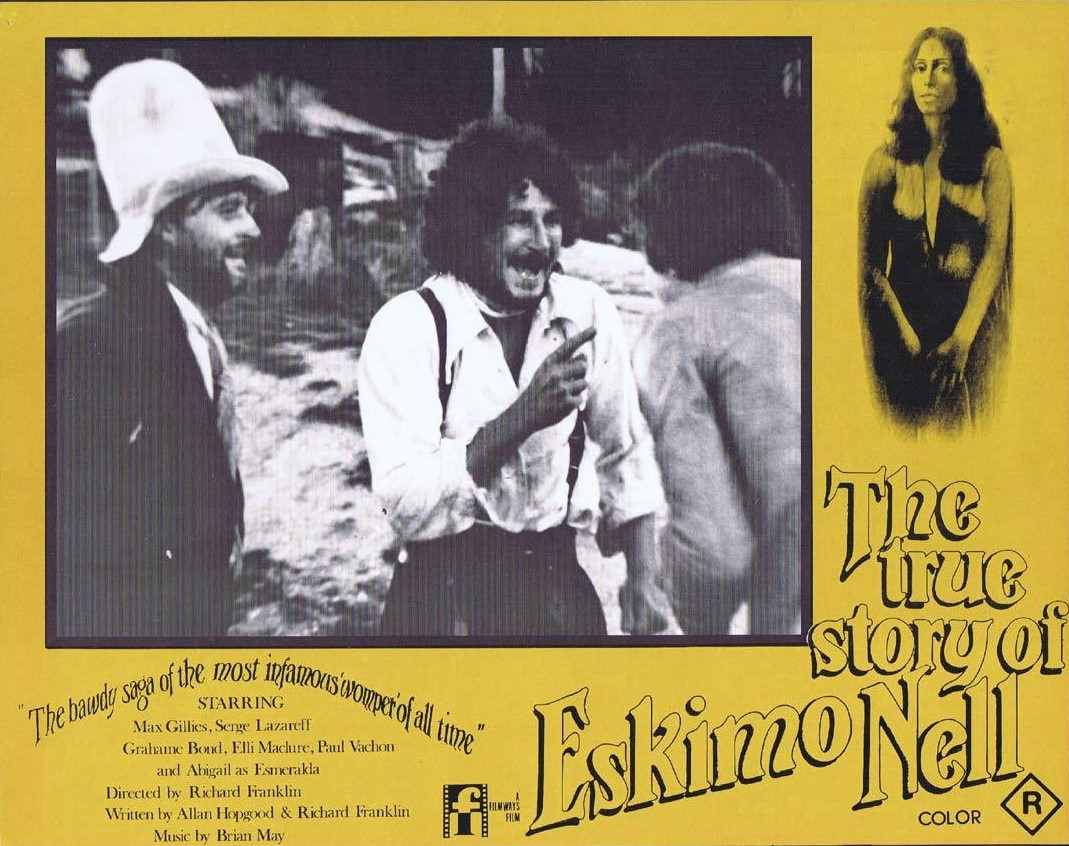
THE TRUE STORY OF ESKIMO NELL (1975)

Title: THE TRUE STORY OF ESKIMO NELL

Year of Release: 1975

Director: Richard Franklin

Genre: Comedy, Sex Comedy, Western, Drama

Synopsis: An unconventional friendship is forged between two men, Dead Eye Dick and Mexico Pete, after Dick saves Pete from a precarious situation one evening.

Within a film history contextAustralian sex comedies began to appear on cinema screens from 1970. Due to the breakdown of Australian film censorship, and a relaxation of what content could appear on screen, sex comedies began to be made from 1970, beginning to largely peter out by 1975. The first of the genre, John B. Murray's THE NAKED BUNYIP (1970) was a semi-documentary about the sexual habits of Australians, with a young man interviewing various people about the topic. It is seen as being not only a milestone in Australian film censorship but also, inaugurated the sex comedy genre in the country. Next came STORK (1971), directed by Tim Burstall. The story of a young man, and his libidinous adventures resonated with the viewing public, as with THE NAKED BUNYIP, and was one of the most successful Australian films until that time. 1973 brought one of the most notable sex comedies produced in the genre, being Tim Burstall's ALVIN PURPLE (1973). As with STORK, it centred around a young man and his raunchy activities, but ALVIN PURPLE went much further in this department, with a preponderance of nudity, specifically female, and sexual situations. The film was an immense financial success of its time and led to a sequel in 1974, ALVIN RIDES AGAIN, and another in 1984, being MELVIN, SON OF ALVIN, although both were not as profitable as the original. 

1975 was notable as a year in which several Australian sex comedies were released, but the impact of earlier productions was not obvious in their box office takings, which were disappointing. THE BOX (1975), directed by Paul Eddey, was a comedy about the goings-on at a fictional television station, and contained a subplot about the entanglements of an ambitious, promiscuous starlet. David Baker's THE GREAT MACARTHY (1975) had an attractive football player whose romantic rendezvous with three different women were charted in this brassy production. THE LOVE EPIDEMIC (1975), directed by Brian Trenchard-Smith, as with THE NAKED BUNYIP, had a documentary leaning, but this time concerned with venereal disease, with some comic asides, and plenty of sex and nudity. Terry Bourke's PLUGG (1975) was an abysmal sex comedy of a private detective on the trail of an elusive female escort, with others also hot on her trail. It was, unfortunately, the lesser of all the Australian sex comedies. In comparison, THE TRUE STORY OF ESKIMO NELL was also released in 1975 at the end of the Australian sex comedy cycle, and is the best of all the movies in the genre.

The movie does have that nonsensical approach to its narrative, and emphasis on sexual matters which marked entries such as ALVIN PURPLE, THE LOVE EPIDEMIC, PLUGG, THE NAKED BUNYIP and, to a lesser extent, THE GREAT MACARTHY. There are depictions of sex and nudity which also definitely earned the first three examples, as well as THE TRUE STORY OF ESKIMO NELL, their 'R' rating restricted certificates, making these films only accessible to adults in the cinema. THE TRUE STORY OF ESKIMO NELL, though, moved away from these in one main manner. While there was a small degree of pathos present in STORK and ALVIN PURPLE, in THE TRUE STORY OF ESKIMO NELL it beautifully infused the picture with its unique tone. Instead of sexuality being a means to an end in the movie, as it was, for example, in ALVIN PURPLE, with a male character sowing his oats, Dead Eye Dick in THE TRUE STORY OF ESKIMO NELL was searching for something of a more spiritual, otherworldly plane. It was not just about the sex here, but about the journey. He does save himself for someone, and something which was utterly contrary in reality to what it was in mythology, and this gave the film its sweet, sad, and emotional feel. In addition to this, there is another feature of THE TRUE STORY OF ESKIMO NELL which separates it from the others in the genre.

The other movies generally concentrated upon a single male character, following his life and, especially, various adventures and dalliances with women. This was a key tenet of STORK, ALVIN PURPLE, THE GREAT MACARTHY, and PLUGG. With THE TRUE STORY OF ESKIMO NELL, it moves away from this single character structure. There are contrasts drawn between the two male characters, being Dead Eye Dick, and Mexico Pete in THE TRUE STORY OF ESKIMO NELL. The former is the unconfident male protagonist, uncomfortable around women, the latter his polar opposite, who had a definite way with the ladies. The path to which Dick and Pete become best friends is one of the most charming aspects of the film. Women notwithstanding, their friendship deepens, and here this male-male friendship blossoms, and finds its zenith at the conclusion of the picture. In effect, THE TRUE STORY OF ESKIMO NELL is a bromance film, moving away from just being about men and their sexual desires, to something more substantial. A great movie with a definite raison d'etre, THE TRUE STORY OF ESKIMO NELL is not only entertaining but also, offers food for thought about male-male friendships, and humanity itself.

Overview: Richard Franklin was an Australian director who made eleven films between 1975 and 2003. Over this twenty-eight-year period he tackled genres such as comedy, sex comedy, horror, and action. His second movie, the softcore FANTASM (1976) was an anthology picture dealing with female sexual desire, presenting these in a no holds barred fashion, with many American pornographic models acting in these segments. It was strung together with a faux psychiatrist introducing these, but the film itself was a success at the Australian box office. Next came horror film PATRICK (1978), a definite change of pace for the director. A murderous comatose patient causes no end of grief in a hospital in a bid to keep his private nurse with him. More horror was on view in ROADGAMES (1981). A truck driver begins to believe that a man is murdering young hitchhikers, enlisting the assistance of a young woman to find the killer. In 1983 one of his best-known films was released, being PSYCHO II (1983). The continuation of the story of creepy Norman Bates, proprietor of the Bates Motel, it was one of Mr Franklin's most commercially successful movies, grossing a healthy profit. Another horror film, LINK (1986), had a zoology student becoming involved in experiments with chimpanzees, the animals turning against her in a dramatic manner. 

More American films followed for Richard Franklin. Action was the main attraction in F/X2 (1991). A special effects man becomes involved in intrigue and murder, specifically to find a killer in this action movie. Richard Franklin returned to more character-driven material with HOTEL SORRENTO (1995). In this picture, a woman returns to her hometown, and after enjoying the success of her novel, this causes problems as the fiction in this case may be based more in fact than first meets the eye. Mr Franklin's penultimate film was BRILLIANT LIES (1996). Sexual harassment was the focus here, with a woman taking her former employer to court for goading her to have sex with him. Richard Franklin's final cinematic outing, VISITORS (2003), was another foray into horror for the director. This film looked at a young woman who sailed on her own around the world, and charted her crumbling mental state. THE TRUE STORY OF ESKIMO NELL marked Richard Franklin's film debut, and was one of his most original works.

With THE TRUE STORY OF ESKIMO NELL, Richard Franklin has made a striking motion picture which rings true in every way. Taking the story of an unlikely friendship between two very contrasting men, Dead Eye Dick and Mexico Pete, the film depicts their bond, from Mexico Pete's initial misgivings about Dick, their developing camaraderie, to events which cement their union. It is a movie which slowly unravels in an entertaining, but also, heartfelt style, making one care about the characters, and what happens to them. The film, admittedly, does have a preoccupation with sexual matters, but these come from the characters, and are not forced. The sexuality, nudity, and language are surface aspects which give way to deeper ponderings, and explorations of male-female, and male-male relationships. It may seem to be a film that is light on first impression, but this is dispelled when it is looked at in more detail.

The movie does posit overwhelming support for male-male friendships within its context, and how women sometimes can be expendable in this respect. To maintain balance the film, though, does contain a scene where Dick and prostitute Ellie do relate on a more profound emotional level as a man and a woman. The variety of elements in the film, though, makes one definite statement about THE TRUE STORY OF ESKIMO NELL. Although the movie is at heart a western with comedy asides, it does have a little of everything, but never becomes overloaded. Comedy, drama, male wish fulfilment, fantasy, tragedy, for example, all receive an airing in THE TRUE STORY OF ESKIMO NELL. Richard Franklin succeeds in keeping everything on an even keel, and when one thinks the movie will go overboard, he pulls back, surprising the audience in the process. One of the most imaginative Australian movies ever, THE TRUE STORY OF ESKIMO NELL deserves a higher critical reception than what it has previously received, and for its director.

Acting: THE TRUE STORY OF ESKIMO NELL benefits from its two main performances, and two supporting contributions. In the lead role of Dead Eye Dick, Max Gillies is excellent. An actor renowned for his impersonations of various real-life figures, here he makes his character not only humorous but also sympathetic, warm, and thoroughly relatable. As his best friend, and cohort Mexico Pete, Serge Lazareff also does a fantastic job. With his likable swagger and way with slang, he and Max Gillies have a chemistry that makes the movie a convincing experience, despite its many raunchy passages. Graham Bond as Bogger, Pete's friend, lends his considerable liveliness to a small part which, nevertheless, adds spice to the movie. The final acting of note was by Elli Maclure as Ellie, a prostitute with whom Dick has a revealing heart to heart talk. An actress who has played in several movies, more on television, here provides an insightful, candid performance which gives another view of femininity which is in contrast to the film's concentration on female nudity.

Soundtrack: Brian May's music for THE TRUE STORY OF ESKIMO NELL ticks all the boxes in terms of the feelings the movie encompasses. Happiness, sadness, pathos, slapstick, hilarity, and many other states, are all expertly evinced by Mr May in his work, immeasurably assisting the movie.

Mise-en-scene: Several personnel have made notable contributions in making THE TRUE STORY OF ESKIMO NELL persuasive onscreen for viewers. Colour cinematography by Vincent Monton is beautiful, capturing hues in a lavish, yet agreeable manner. One of the best uses of colour is the scene where Dick rescues Nell, reminiscent of the ice floe sequence of WAY DOWN EAST. Art direction by Josephine Ford and Ray Wilkinson creates a wild west which convinces not only visually in its detail but also, has an endearing nature of familiarity in its tone. Costuming by Aphrodite Kondos captures the personalities of all characters to a tee, from Dead Eye Dick to Mexico Pete, Bogger to Eskimo Nell herself. 

Notable Acting Performances: Max Gillies, Serge Lazareff, Graham Bond, Elli Maclure.

Suitability for young viewers: No. Infrequent coarse language, male nudity, female nudity, adult themes, medium-level violence.

Overall Grade: A

LinkIMDB Page

Trailer


Tuesday, October 4, 2022

THE COOLANGATTA GOLD (1984)

Title: THE COOLANGATTA GOLD (Alternate title: THE GOLD AND THE GLORY)

Year of Release: 1984

Director: Igor Auzins

Genre: Drama, Sport, Romance

Synopsis: Two brothers aim to compete in The Coolangatta Gold iron man race to appease their father, but he only supports the aspirations of his eldest son in this, causing a rift with his younger son.

Within a film history context: Films with a father-son conflict at their core have been in existence in cinema history since the sound era, with several notable examples. One of the first documented was F.W. Murnau's CITY GIRL (1930). In this movie, a woman marries a farmer, but has to face many difficult situations in her new life. Adding to her issues is the fact that her father-in-law refuses to accept her, this causing a wedge not only in her marriage but also, between father and son. With the exotic FIESTA (1947), directed by Richard Thorpe, a young man does not want to follow in his father's footsteps as a matador, this causing dissension between them, and complicating his sister's life in the process. Mervyn LeRoy's ANY NUMBER CAN PLAY (1949), featured Clark Gable as a casino proprietor whose activities impact not only upon his wife but also, his son, who disagrees with his father's business dealings. CONFIDENTIALLY CONNIE (1953), directed by Edward Buzzell, was of a more comic persuasion. It focused upon a college professor and his wife, and his father with whom he is at odds over the family ranch, where he does not wish to return. 

Edward Dmytryk's BROKEN LANCE (1954) followed a crusty ranch owner, and his four sons. Conflict emerges from how he treats the three older sons of his first marriage, and the very different, close relationship he shares with the youngest son from his second marriage. Western THE HALLIDAY BRAND (1957), directed by Joseph H. Lewis, concentrated upon the wrought relationship between a son and his father, who was an unorthodox sheriff who tried his best to control the lives of him and his siblings, his one son the only person able to take him on. An aristocratic take on matters was offered by Terence Young's MAYERLING (1968). An Austrian prince has a hostile relationship with his father, due in part to the patriarch's insistence on maintaining the status quo of the social order, his son holding more contemporary beliefs in 1880s Austria. Devious doings were the order of the day in THE HORROR OF FRANKENSTEIN (1970), directed by Jimmy Sangster. An utterly odious young man has a falling out with his father over his anatomy experiments, and subsequently kills him, continuing his mission to construct a body, which causes no end of grief. THE COOLANGATTA GOLD was a movie where the father-son conflict was one of the main drivers of action in the narrative.

The father-son difficulties were largely based upon the father's insecurities in THE COOLANGATTA GOLD, and how he came second in a surfing marathon in 1960. The father sees his younger son as the weak link in the family, as he is more motivated toward artistic pursuits such as being a rock band promoter, rather than an athlete. The son sees life in a less competitive manner, just wanting to do what he does, without the burden of being the best. He is constantly berated and belittled by the father, who sees the older son, and brother, as the child who will fulfill his dream of winning the surfing marathon. There are, in effect, elements of the stage father in this movie, which is far removed from the other portrayals, with fathers and sons not connecting for one reason or another.

FIESTA and CONFIDENTIALLY CONNIE had sons who did not want to continue in the life goals of their respective fathers, but THE COOLANGATTA GOLD stood out as the younger son actually wanted the love and esteem of his father, and tried to please him, but could not achieve this. The father could never see the younger son for who he was, and what he wanted out of life. In THE COOLANGATTA GOLD, it was always about what the father wanted for his sons, but not what they wanted for themselves. There was a tragic undertone to the movie where two family members could never see eye to eye, with feelings of resentment expertly depicted. It could be said that Steve in THE COOLANGATTA GOLD was similar to the son in THE HALLIDAY BRAND who tried to break away from his father's influence and carve his own identity. The use of the love interest in THE COOLANGATTA GOLD is also something which diverts from other movies with a father-son conflict.

In CITY GIRL, the father-in-law causes his new daughter-in-law many precarious moments, and, in turn, his son with the treatment of his wife. The wife in ANY NUMBER CAN PLAY is neglected by the husband for his work, and in MAYERLING, the prince has an affair with another woman to take his mind away from his loveless marriage. In THE COOLANGATTA GOLD, matters are much more subtle, and muted in tone. There is none of the melodrama which marked the other movies, but Steve and Kerri meld together in a natural way, real life and emotions making an impact on them. A backwards and forwards momentum marks their union, with Steve's personal, and professional difficulties highlighted, and Kerri's ballet obligations the issues. In addition, Steve's father views his attraction to Kerri as humorous, which is another deviation from the above movies, and view of male-female relationships, and prospective father-in-law. Steve's father does not even exchange a word with his son's love, even though he sees his son speaking with her on the beach, and at the hospital. For these reasons, offering a meaty view of father-son conflict, THE COOLANGATTA GOLD is one of the most extensive on the topic.

Overview: Igor Auzins is an Australian director who has helmed three motion pictures, being more active on television in episodic series, and telemovies. His first movie, HIGH ROLLING (1977), was a rollicking action film about the adventures of two carnival workers, with Joseph Bottoms in the lead role. Mr Auzins' second movie, WE OF THE NEVER NEVER (1982), was an historical story set in early 1900s Australia which had a warm critical reception at the time of its release. It also received a number of awards and nominations in various departments. THE COOLANGATTA GOLD was Igor Auzins' last movie, and one of his most-recognized cinematic efforts.

With THE COOLANGATTA GOLD, Igor Auzins has crafted a strong film which makes a definite impression on the emotions. Taking a deceptively simple narrative line by exploring a family, and how a father wants his eldest son to win an ironman race, effectively casting his younger son aside in the process, it keeps the spectator involved with the various viewpoints, and character desires and needs that are expressed. While there are some fiery moments, these are not forced, and come from the characters with a basis in honesty. The movie itself plays out in a naturalistic manner, eschewing obvious melodrama that can sometimes be jarring. This is one of the merits of THE COOLANGATTA GOLD, being that it is never over the top in its execution. Although the film has certain assets, it does, unfortunately, have downsides which take it down a few notches.

The first half of the movie does establish what is taking place, where, how, and why, but one wishes some sections could have been abbreviated. Several examples come to mind. The sequence where it is revealed that Steve aspires to be a rock band promoter, with the band playing a song in the background, while valuable as insight into his ambitions, is overlong. The song played also is not memorable in any way, especially when compared to a later song in the roof garden scene played by the band. The roof garden scene itself also takes too long to unravel, but the movie makes up for this with Adam's predicament, and the fallout from this. In addition, the later love scene between Steve and Kerri was a tacky 1980s segment that did absolutely nothing to further the story. As with the previously mentioned scenes, it was presumably included to be fashionable for its time, but all seem dated in retrospect. Thankfully, the second half of the movie picks up steam, and the various confrontations and character interactions are closer in proximity, making for a better film. The ending of the film is excellent, where all the pieces come together in a cohesive whole. In looking at the movie as a whole, certain things can be said about THE COOLANGATTA GOLD. It is a stirring film which deserves a higher reputation than what it has had in the past for the affecting experience it delivers to the viewer.

ActingTHE COOLANGATTA GOLD boasts fine performances from its cast which bolster its impact. In the lead role of Steve Lucas, a young man seeking to attain his father's love, but finding this an impossible task, Joss McWilliam is excellent. An actor for whom this was his debut role, he makes Steve a person of many edges, with passion, humor, anger, and sensitivity recalling the volatility James Dean displayed in his parts. As Joe, his father, and the thorn in Steve's side, Nick Tate shows why he is one of Australia's best actors. A performer adept at playing all sides of the emotional spectrum, his Joe could have been a caricature in other hands, but he manages to make him understandable and even sympathetic, despite Joe's treatment of his son. Colin Friels, as the favourite son of Joe, Adam, makes him a strong, but often silent figure in the movie. An actor who instinctively knows how to use his face and eyes, saying much in a non-verbal manner, Mr Friels is another attraction in the picture. His dance scene with Josephine Smulders' Kerri shows him an ace on the floor with his moves. Three other actors contribute great acting in the movie.

As Robyn, wife of Joe, and mother of Steve and Adam, Robyn Nevin is well-cast in a small role which she nevertheless makes the most of in the limited time she has onscreen. An actress who always brings conviction to her parts, making her characters believable to the core, she gives another viewpoint to the film, taking some attention away from the largely all-male perspective displayed. The ballerina who captures Steve's heart is given subtle treatment by Josephine Smulders. A ballerina in real-life for whom this was her only screen role, she is well-matched with Joss McWilliam, her serene and thoughtful nature a nice contrast to Steve's excitability and nerviness. The last actor of note in the film is Paul Starling as Steve's karate instructor. In real-life Mr Starling is a martial artist and karate master, and in the movie brings notes of authority and determination to his role as Steve's instructor, and closest confidant.

Soundtrack: What is most striking about musical accompaniment in THE COOLANGATTA GOLD is Bill Conti's rousing score. It is alternately quiet, passionate, spirited, and suits the story of people striving for the best they can achieve. Additionally, it provided the film with a sense of wonder and grandeur that the visuals many times lack, making up for this considerably. Aside from this, the movie has several rock and pop tunes which do not make an impression on the senses, the best of all these being 'Fraction Too Much Friction', performed by Wilbur Wilde. It functions not only in a pleasant manner, but also as a diegetic comment on the lives of its characters, particularly brothers Steve and Adam in this part of the movie. 

Mise-en-scene: What appears onscreen for viewers in THE COOLANAGATTA GOLD is one of its most problematic aspects. On the one hand, cinematography by Keith Wagstaff is crisp and clear, especially beautiful during the scenes on the beach such as the iron man race, taking advantage of the sun-drenched locations. On the other hand, the locations chosen for the movie, such as the Lucas family home and its surroundings, are unattractive, and do nothing for the film. It could be said that the family home is reflective of its characters, but visually is a liability. This, though, is symptomatic of many Australian films over the years, being how unappealing locations are spotlighted, possibly to create an image of realism, but they offer nothing but an eyesore to viewers. There is also the tendency to plunge the movie into darkness at times, such as the roof garden scene, the car park sequence, and, the private areas of the Lucas family home. Having more agreeable locales would have given the film a boost that the sets and places it utilized just do not possess. In the case of THE COOLANGATTA GOLD, these are not the best backdrop for its excellent cast, failing to serve them properly.

Notable Acting Performances: Joss McWilliam, Nick Tate, Colin Friels, Robyn Nevin, Josephine Smulders, Paul Starling.

Suitability for young viewers: Parental discretion advised. Infrequent coarse language, brief male nudity, brief female nudity, adult themes.

Overall Grade: B

LinkIMDB Page

Trailer