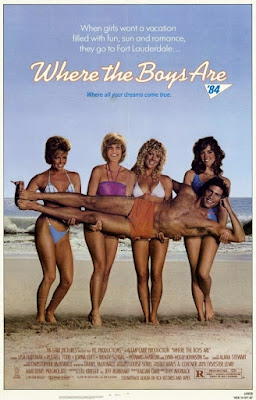
Tuesday, January 4, 2022

HOLLYWOOD HOT TUBS (1984)

Title: HOLLYWOOD HOT TUBS

Year of Release: 1984

Director: Chuck Vincent

Genre: Comedy

Synopsis: A young man vandalizes the Hollywood sign, and is consequently sent by his probation officer to work at his uncle's hot tub business, where he becomes involved in many zany situations.

Within a film history context
Sex comedies released in the 1980s were a common fixture on cinema screens during the decade, with an array of themes and topics explored in this time period. These were a mixture of films with mainly adult protagonists, and others with predominant teen characters, or both. One of the first was Gilbert Cates' THE LAST MARRIED COUPLE IN AMERICA (1980). The study of a middle-aged couple's marriage, and the influence on them of outside unions, gave Natalie Wood and George Segal great roles as the central duo. A teen-oriented spin on sex comedies was provided by THE HOLLYWOOD KNIGHTS (1980), directed by Floyd Mutrux. The adventures of a car club consisting of teenagers during an evening in 1965 was reminiscent of AMERICAN GRAFFITI, but with nudity and sexual situations not present in the latter movie. In retrospect, THE HOLLYWOOD KNIGHTS was mainly notable for the appearances of up and coming actors such as Michelle Pfeiffer, Tony Danza, and Fran Drescher. Joseph Ruben's GORP (1980) was in a similar vein. The antics of teenagers in a Jewish summer camp made up the content of this picture, also with a cast of now-familiar faces such as Dennis Quaid, Rosanna Arquette, and, once again, Fran Drescher. Adultery, on the other hand, was the crux of LOVING COUPLES (1980), directed by Jack Smight. In this movie, a couple cheat on each other with people who are connected, with comic results. 

One of the most recognized, if infamous, sex comedies of the 1980s was Bob Clark's PORKY'S (1981). This tale of high school students in 1954 Florida, highlighting their sexual exploits, and the shenanigans of the eponymous club, was a tremendous box-office success, if critically derided, and led to two sequels. Equally saucy in tone was PRIVATE LESSONS (1981), directed by Alan Myerson. The story of a tryst between a young man and his family's maid was high on sexual content, but made a great profit to its producers on this basis. Blake Edwards' S.O.B. (1981) revolved around a Hollywood film producer who had just made his first flop, and how he tried to rescue both the movie, and his reputation, by turning the picture into a soft-core production. With SO FINE (1981), directed by Andrew Bergman, a man in financial straits develops a style of jeans that become a sensation - pants with the buttock area exposed. In comparison, Richard Brander's MALIBU HOT SUMMER (1981) examined the sexual, and other activities of three young women co-renting a Malibu beach house. The movie is mainly of interest historically, though, as Kevin Costner's film debut. Another film with three female protagonists was WAITRESS! (1981), directed by Lloyd Kaufman and Michael Herz. In this movie, three young women become involved in all manner of raucous incidents, such as battling amorous customers and crazy cooks. Charlie Loventhal's THE FIRST TIME (1981) was about a young film student pursued by young women only too ready to offer themselves to him, but having to put up with his wacky film professor at the same time. 

Taking a leaf out of MALIBU HOT SUMMER was THE BEACH GIRLS (1982), directed by Bud Townsend. Two college friends visit their demure companion who is living at her uncle's beach house, and effectively take it over, hosting wild parties and the like, the quiet young lady eventually letting her hair down in the process. Alternately, Bruce Paltrow's A LITTLE SEX (1982) had a young Lothario almost ruin his marriage with his womanizing antics in this comedy romance. Shades of PORKY'S were evident in THE LAST AMERICAN VIRGIN (1982), directed by Boaz Davidson. A trio of male high-school student indulge in sexual antics with the usual exploits and female nudity thrown in, but with some serious moments interspersed. Akin to this, but with a much more humorous slant was Robert Rosenthal's ZAPPED! (1982). A high school student discovers he possesses telekinetic powers, and uses these to not only exact revenge on some bullies, but also for erotic stunts. FAST TIMES AT RIDGEMONT HIGH (1982), directed by Amy Heckerling, was about the mis-adventures, specifically of the sexual kind, of high school students in a California high school. Notable for making stars of many of its performers, such as Sean Penn and Judge Reinhold, it grossed a healthy profit for its studio. 1983 had a number of films in the sex comedy genre which explored varied themes and topics. 

Sean S. Cunningham's SPRING BREAK (1983) focused upon two young men who go to Florida for their spring break, with associated episodes of comedy, sex, and topless female nudity. Raunchy nostalgia was again on display in SCREWBALLS (1983), directed by Rafal Zielinski. Set in the 1960s, this film was concerned with the antics of several high school students obsessed with a local beauty, and led to two sequels. A definite period atmosphere was evoked by Gerry O'Hara's FANNY HILL (1983). Set in 1700s Britain, a young woman moves from one bed to another seeking not only carnal pleasure but also, happiness, in this erotic comedy. A sex comedy which rang the box office bell was RISKY BUSINESS (1983), directed by Paul Brickman. A young prospective college candidate holds a wild party while his parents are absent, but not everything turns out the way he expected in this insightful movie. Less edifying was Michael Herz and Lloyd Kaufman's THE FIRST TURN-ON! (1983). This movie followed the racy happenings at a summer camp, with lots of sexual content and nudity as per this genre's general tone. More serious was THE MAN WHO LOVED WOMEN (1983), directed by Blake Edwards. A sculptor finds that his need to have women in his life leads him to therapy, and subsequently falls for his doctor. This was a quieter, more subtle addition to the genre, and gave its cast, headed by Burt Reynolds in the lead role, good opportunities to emote. 

Curtis Hanson's LOSIN' IT (1983) once again traversed through nostalgia territory, with four young men in 1965 determined to rid themselves of their virginity, and undertaking the usual escapades these movies followed. Mainly notable for its cast including Tom Cruise, Jackie Earle Haley and Shelley Long, it was a loss-maker for MGM. Another sojourn into teenage frolics was served by JOYSTICKS (1983), directed by Greydon Clark. The move to close a small town video arcade by a businessman elicits anger in its patrons, and they retaliate in a non-violent, but comic manner. As with PRIVATE LESSONS, the older woman/younger man concept was again on show in Lewis John Carlino's CLASS (1983). A sensitive young man studying in preparatory school becomes friendly with a fellow student, who encourages him to find himself. Going to Chicago, he meets an older woman, and begins an affair, but is rocked when he discovers her real identity. MY TUTOR (1983), directed by George Bowers, was another film in the older woman/younger man context. In this instance, a wealthy man employs an attractive tutor for his son, who needs to pass French class to enter university. As with PRIVATE LESSONS and CLASS, the film follows the same formula of an irresistible older woman seducing an eager younger man, with obstacles and misunderstandings placed in their way. HOLLYWOOD HOT TUBS exhibited many of the attributes of the 1980s sex comedies, but had its own distinguishing features.

HOLLYWOOD HOT TUBS was reminiscent of the sex comedies which portrayed a number of characters either indulging in outlandish hijinks to shock others, such as THE HOLLYWOOD KNIGHTS and PORKY's, or that occur to them on account of their involvement in a situation, such as WAITRESS! HOLLYWOOD HOT TUBS is closer in context to WAITRESS! on account of the fact that it was set in a work environment, in the case of HOLLYWOOD HOT TUBS, a company which services hot tubs. Both films have characters who encounter wacky people along the way who cause the majority of the humorous set pieces. With HOLLYWOOD HOT TUBS, though, there is a lead character, a male juvenile delinquent who is placed in the work situation as the main focus, instead of a number of people. The presence of a male protagonist finding himself in compromising positions was also a common thread in PRIVATE LESSONS, CLASS, and MY TUTOR, where the younger man has a relationship with an older woman. In HOLLYWOOD HOT TUBS, it is mentioned that Shawn is a minor, but his union with Leslie, who the film makes out to be older than him, is not in the same league as the afore-mentioned films, whereby considerably older women make a play for younger men. Shawn actively squires Leslie, instead of her pursuing him. Aside from this, HOLLYWOOD HOT TUBS was also of interest for some other features.

Having the action set in a work milieu was refreshing, for the fact that many of the stories within the movie emerged from whom the employees came into contact. Each and every character was well-defined in the hot tub service company, from its owner, to the secretary, to the Lothario manager, and the rookie recruit Shawn. While the main characters could be classified in some ways as stereotypes, they could actually have existed in real life, making them plausible, even if what happens to them is over the top in many instances. It was not a case of people going on holiday, looking for fun and other things in HOLLYWOOD HOT TUBS, as in SPRING BREAK, MALIBU HOT SUMMER and THE BEACH GIRLS, which is an overused device even at the best of times. Another facet of HOLLYWOOD HOT TUBS is worth examining for how it diverts from the other sex comedies.

In many of the films, with ZAPPED!, SCREWBALLS, PORKY'S, and THE LAST AMERICAN VIRGIN in particular standing out, female nudity, men looking at, or spying on unclad women, having their clothing ripped away from them, was a key tenet. Men were largely the aggressors, or dominant here. With HOLLYWOOD HOT TUBS, women play a different role than the men during the course of the movie. The most centered women in the narrative are Leslie and Pam. Leslie likes Shawn, but misinterprets a scene with him sharing a tub with some other women where he was innocent, and snubs him. There is the implication that she is a one woman man, and holds her ground accordingly. Pam indulges in an affair with a younger man, initiating their union, but when he admits his business aspirations were the impetus for the affair, she ends it with him. There is a sense of female emancipation present in both of these stories where the woman seeks equality with a man somewhat missing in the afore-mentioned examples.

In terms of nudity, HOLLYWOOD HOT TUBS does have scenes with topless women, but these women take on the men, assuming a dominant role when they spy on them, or try to seduce them. It is a different perspective on the more powerless women seen in the other films just as eye candy. HOLLYWOOD HOT TUBS throws another wrench in the works with its depiction of homosexuality. Having a virile gay man at a bath house pull into a private room, and seduce, the heterosexual probation officer, was a surprising twist in the movie where many of the women, instead of the men, had an overactive libido. It takes things to whole new level of gender relations that are most unexpected. It implies that a 'real' man can satisfy another man on a sexual level, and bring the nervy heterosexual man 'release', which appears to have occurred to Mr Slate. For these reasons, HOLLYWOOD HOT TUBS is one of the most amusing, complex sex comedies ever made, and a deceptively simple movie with a sting in its tail.

Overview: Chuck Vincent was principally a director of X-rated hardcore pornographic movies, but also had many R-rated features in his filmography during his eighteen year career. His first feature film, VOICES OF DESIRE (1972) was about a young woman who believes she was involved in a murderous cult, hearing voices to this effect. BLUE SUMMER (1973) was a comedy with several teens taking to the road in search of sex and adventure. MRS. BARRINGTON (1974) was a black comedy with a homicidal woman marrying wealthy men, killing them, and ending up with their money. Mr Vincent then tackled comedy again with AMERICAN TICKLER (1977) which spoofed several American movies such as JAWS and KING KONG. Marital comedy A MATTER OF LOVE (1979) focused upon two couples who exchange spouses while on holiday. SUMMER CAMP (1979), on the other hand, followed the antics at a camp which needs financial assistance, the owner hoping former patrons will help him. Less than subtle, though, was HOT T-SHIRTS (1980) where a man in financial strife opts to go down-market by initiating a wet t-shirt contest to lure business to his bar. PREPPIES (1984) revolved around three young women who scheme to prevent several university students from passing their course, thereby making them ineligible for a large sum of money. With SEX APPEAL (1986) a young man sets out to change his life, moving away from his family home, seeking to attract women, but falling into problems trying to increase his sex appeal. Chuck Vincent had a change of pace with the suspense film IF LOOKS COULD KILL (1986). A private investigator is hired to keep tabs on a woman, filming her, but she is murdered, and he is implicated in the offence, later trying to prove his innocence of the crime. 

Mr Vincent took a detour into historical territory with ancient Pompeii on view on WARRIOR QUEEN (1987). Inequity reigns in ancient Pompeii, with slavery a hot bed of corruption, but the titular queen surreptitiously assists the slaves to break free. It was back to comedy for Chuck Vincent with YOUNG NURSES IN LOVE (1987). The sperm of Albert Einstein and Thomas Edison is pursued by Russian agents who want to steal it, and return with it to Russia in this farcical movie. More comedy was on show in SLAMMER GIRLS (1987). Being framed for something she did not do, a young woman is placed in a facility with underhanded staff members. A reporter wanting to assist the woman is also jailed, seeking to make public what is taking place in the prison, and also proving the young woman innocent. DERANGED (1987) had a horror theme, with a woman killing a burglar, and subsequently losing her grip on reality, and murdering anyone in sight. It was back to comedy for Chuck Vincent with STUDENT AFFAIRS (1987), being the story of a crew making a movie about high school in the 1950s. Another film with a humorous slant, SENSATIONS (1988), focused upon two people, one a prostitute, the other a roguish man, who each have half of a lottery ticket. Things become complicated for them as the only way they can collect the money is to marry, and thus present themselves as a couple. 

Chuck Vincent made another thriller with BAD BLOOD (1988). In this moody film, a woman believes her deceased husband has come back to life as her son. Another thriller, THRILLED TO DEATH (1988), revolved around a married couple who became entangled, through his research about swinger's clubs, with a swinger couple who have more to them than first meets the eye. Shifting gender identities were explored by Mr Vincent in CLEO/LEO (1989). A man who falls off a bridge after being shot by a venomous woman emerges from the river as a woman, Cleo, who tries to take over Leo's life, with amusing results. ENRAPTURE (1989) traversed thriller material again, with an actor working as a chauffeur becoming entrapped in murder via his involvement with a woman. Mr Vincent's penultimate film, WILDEST DREAMS (1990), was a comedy about a young man working in an antique store releasing a genie from her bottle, and what happens when she permits him three wishes. Chuck Vincent's final film, SEXPOT (1990), was a retread of his earlier MRS. BARRINGTON, with a woman marrying, and organizing, the imminent death of her moneyed spouses. HOLLYWOOD HOT TUBS was one of Chuck Vincent's best-known R-rated films, and one of his most enjoyable movies.

Chuck Vincent has fashioned an entertaining, humorous motion picture with HOLLYWOOD HOT TUBS. There is a nice flow overall to the film, with Mr Vincent ensuring a sweetness, and innocence in its tone, despite the subject matter dipping its toes heavily into bawdiness in many an instance. Having the action set in a workplace, studying the different characters, their interactions, and with those they come into contact, is where the movie is at its peak. The comic repartee between characters, the one-liners, realizations, all work in a natural manner, without reducing the characters into caricatures. The raunchiness is delivered with ease by the cast, and a lack of self-consciousness. In a related way, the array of comic set pieces have been carefully arranged for maximum impact, with some being genuinely funny, in spite of the heady nature of some of these. While HOLLYWOOD HOT TUBS has some good aspects, there are deficiencies present when the movie is examined on closer viewing.

In seeking to keep HOLLYWOOD HOT TUBS light and bright throughout, this move makes certain plot points and details, which could have been more striking, trivial in retrospect. One understands where the characters are coming from in every way, but the tendency to make them two-dimensional robs them of added depth. Mrs Wright is dependent upon valium for her anxiety, her son Shawn's antics with the Hollywood sign exacerbating this, but it is just treated for laughs instead of the real-life issue it is. While this is a comedy film and it is expected that situations are bound to be sent up, it feels a little hollow. Al Rey, owner of the Hollywood Hot Tubs business, is played with conviction, but not given a private life. It would have been nice to witness a scene where he may talk about this, but it never appears. The character given a more three-dimensional treatment in HOLLYWOOD HOT TUBS is Pam Landers. An authoritative, single businesswoman with a grown daughter, there is a scene which fleshes out her life, and this is the most revealing point in the movie. These more intimate moments, though, are few in the picture. A film dealing with sexual elements and comedy is not by nature very profound, but this was the intention with this movie, being pure entertainment. A rollicking film with some highly amusing passages, HOLLYWOOD HOT TUBS is a fun viewing experience from director Chuck Vincent.

Acting: HOLLYWOOD HOT TUBS has a talented cast who all provide enthusiastic performances, giving the movie a big boost. As Shawn, Paul Gunning has a devilish glint in his eye which makes him entertaining. Neither the innocent, nor an utterly scheming juvenile, his understated acting works. Stafford Morgan gives authority and stature to his role as Al Rey, Shawn's uncle, and the owner of the hot tub business for which Shawn eventually works. As the lively Jeff, working in Al's business, Michael Andrew gives richness to his role as the slightly underhanded, but friendly Jeff. The apple of both Shawn and Jeff's eye, Donna McDaniel, as Leslie, is another authentic performance. The young woman who does not want her heart broken, and puts on a business-like front when it comes to love, Miss McDaniel's young career woman is utterly convincing. 

Remy O'Neill, as Pam Landers, owner of a hot tub business, is the older version of the career woman, but with equal weight. Miss O'Neill's Pam is a more complicated woman who has seen the best, and worst of life, and carries this off in the film beautifully. As Crystal, Pam's daughter, Jewel Shepard has one of the most difficult roles in HOLLYWOOD HOT TUBS. Maintaining not only a Valley girl accent, and keeping her mammaries moving for her screen time, Miss Shepard shines in her comic role. Her chemistry with Remy O'Neill is also evident, seeming like a real mother and daughter. The film's probation officer is played with pushy charm by Mark Costello. Seeming every bit the no nonsense official, Mr Costello is utterly convincing. The last player of note was Rex Ryon as Jesse, Pam's accident prone biker brother. Sounding like Elvis Presley with his Southern voice, and with an imposing physical stature, Mr Ryon makes the most of his role, bringing a vulnerability along with the gruff which is very entertaining to witness.

Soundtrack: HOLLYWOOD HOT TUBS has a number of pop tunes scattered throughout the course of the movie which reflect the nature of the 1980s in which the movie was made. The most prominent was 'Good Radio', performed by Jason Scheff, which is played during the opening credits, and closing credits sequence.

Mise-en-scene: The movie has a very good grasp of mise-en-scene which is reflected in many departments. The use of locations, such as Al's hot tub company, with its office and yard filled with parts, Pam's hot tub business, and the gay bathhouse, to name a few, all seem authentic, and give HOLLYWOOD HOT TUBS verisimilitude. Outdoor location filming is also noteworthy, with the overhead shots of Los Angeles providing viewers with a birds eye view of its milieu. There are also some zany set pieces, such as Edgar Blood's limousine, complete with hot tub in the rear, which are in keeping with the film's wacky nature. Costuming is appropriate to the movie's casual aura, with Pam's party the only formal event in the film, with suits and dresses a definite contrast to the jeans, t-shirts, and more casual attire sported by the cast for the remainder of the movie.

Notable Acting Performances: Paul Gunning, Stafford Morgan, Michael Andrew, Donna McDaniel, Remy O'Neill, Jewel Shepard, Mark Costello, Rex Ryon.

Suitability for young viewers: No. Infrequent coarse language, male nudity, female nudity, adult themes.

Overall GradeC

LinkIMDB Page

Trailer


Saturday, January 1, 2022

THE BELL JAR (1979)

Title: THE BELL JAR

Year of Release: 1979

Director: Larry Peerce

Genre: Drama

Synopsis: The emotional issues, and life of a talented young female writer from 1950s New England.

Within a film history context: Movies about mental illness plaguing female protagonists have been featured many times in cinema history. One of the first in a major motion picture can be found in Harold S. Bucquet's YOUNG DR. KILDARE (1938). In this first entry of the multi-part series, Dr Kildare assists a young woman who has attempted suicide, and almost ends up out of his position at the hospital for this, but all ends well for the young woman, and Dr Kildare. ALL THIS, AND HEAVEN TOO (1940), directed by Anatole Litvak, featured a paranoid, selfish woman jealous of her children's kindly governess, going to great lengths to defame her. Based upon a true story of French aristocracy, it starred Bette Davis as the governess, and Charles Boyer as the Duc in love with her. Another Bette Davis vehicle, Irving Rapper's NOW, VOYAGER (1942), featured Miss Davis as an emotionally distraught young woman dominated by her unyielding mother. After spending time in a mental health facility, and going on a cruise, romance comes knocking at her door. LEAVE HER TO HEAVEN (1945), directed by John Stahl, was about an unbalanced young woman who causes much heartache to her family, particularly her husband and sister. A lushly photographed technicolor film, something unusual at the time for melodramas, which were generally shot in black in white, it showcased an amazing performance by Gene Tierney as the beautiful, acidic Ellen Berent. 

John Brahm's THE LOCKET (1946) charted the life of a young woman in flashback, from her childhood until she was an adult, and how she developed anti-social tendencies which led to her mental collapse. With DISHONORED LADY (1947), directed by Robert Stevenson, a magazine editor has a nervous breakdown, and leaves her position, thus changing her life. Ghosts of the past continue to haunt her, though, and she becomes involved in murder. Mental illness was also at the core of Curtis Bernhardt's POSSESSED (1947). An incoherent woman found roaming the streets of Los Angeles is admitted to hospital. She begins to recount what occurred to bring her to this point, in this strong drama with Joan Crawford in one of her best roles. Equally challenging was THE SNAKE PIT (1948), directed by Anatole Litvak. In this film, a young woman's stay in a mental health facility is explored as she battles many demons, along with staff members and patients, in this potent movie. Into the 1950s many other films looked at mental illness, and how they bedeviled female protagonists.

Billy Wilder's SUNSET BOULEVARD (1951) featured a silent film star who wanted to make a comeback into the movies, drawing a screenwriter into her world, which was filled with fantasy, and delusional behavior. Another disturbing view of mental illness was in A STREETCAR NAMED DESIRE (1951), directed by Elia Kazan. A woman with mental issues moves in with her sister, and brother-in-law in a New Orleans apartment, clashing dynamically with both of them in this memorable movie. Roy Ward Baker's DON'T BOTHER TO KNOCK (1952) was notable in that Marilyn Monroe played against type as a psychotic babysitter, in complete contrast to her roles as an innocent, sensual young woman. One of the most famous films about mental illness afflicting a female character was in THE THREE FACES OF EVE (1957), directed by Nunnally Johnson. A young woman suffers mightily from having multiple personality disorder, assuming the identity of three very different women. An extremely well-acted movie, particularly by Joanne Woodward in the lead role, it was one of the toughest, but sympathetic views of mental illness captured on film. 

Another take on the topic was offered by John Cromwell's THE GODDESS (1958). A young woman becomes a movie sex symbol, but her inner demons spill out into her life, irrevocably affecting it. A definitively more exploitative take on mental illness was served up by SCREAMING MIMI (1958), directed by Gerd Oswald. A dancer witnesses a murder and is psychologically tormented by this event, subsequently admitted to hospital. She is suspected of a series of murders, but all the while pursued by a madman, who wants to kill her. Joseph Mankiewicz's SUDDENLY, LAST SUMMER (1959) was a compelling drama about a young woman shattered by seeing her cousin murdered, who afterwards falls ill. Her imperious aunt wants her to have a lobotomy to cover up what happened, but the young woman is assisted by her psychiatrist in getting to the truth. As with the 1950s, the 1960s had many varied depictions of female mental illness in cinema.

SPLENDOR IN THE GRASS (1961), directed by Elia Kazan, was a lush drama about a young woman in 1920s Kansas, and how her love for a handsome man drives her to emotional instability. One of the early 1960s films which dealt with sex and relationships in an adult manner, it was another motion picture which pushed the boundaries of the slowly eroding Hays Code. Frank Perry's DAVID AND LISA (1962) was also sensitive, this time following the blossoming relationship between two young people in a mental facility, with both male, and female mental illness spotlighted. On the other hand, bizarre was the word for WHATEVER HAPPENED TO BABY JANE? (1962), directed by Robert Aldrich. The story of two sisters, one a former child star with mental problems, the other physically challenged, also an actress, had many memorable moments. This horror-thriller was financially successful, and also lauded for the performances of its two lead actresses, Bette Davis, and Joan Crawford. Even more extreme was William Castle's STRAIT-JACKET (1964). A woman who killed her husband, and lover many years ago is released from a sanatorium, and suspected when a murder spree begins, but her emotionally distraught daughter may have more to do with this than first meets the eye. LILITH (1964) directed by Robert Rossen, was the tale of a young woman in a mental hospital, and her relationship with a war veteran with psychological issues, which is curtailed by the woman's unsavory sexual appetites.

Another way-out vehicle for Bette Davis was Robert Aldrich's HUSH...HUSH, SWEET CHARLOTTE (1964). This time around, Miss Davis was an aging Southern belle with a checkered past, specifically how a murder committed years ago has an enormous impact on her many years later. Also creepy was REPULSION (1965), directed by Roman Polanski. A young woman who has issues with sex is subjected to horrendous experiences, and commits unspeakable crimes of her own, in this spine-tingling movie. Into the later 1960s, Noel Black's PRETTY POISON (1968), in contrast, was of a more irreverent tone. A young woman with sociopathic tendencies hooks up with a young man just released from a mental hospital, lying that he is a secret agent. She believes him, and later enmeshes him in two acts of murder. A Gothic take on mental illness was obvious in SECRET CEREMONY (1968), directed by Joseph Losey. In this film, a woman, Leonora, mourning her daughter's death meets Cenci, an odd young woman at the cemetery. Resemblances to Leonora's late daughter can be found in Cenci, with the young woman's mother likewise with Leonora, with Leonora becoming involved in Cenci's turbulent life. Robert Altman's THAT COLD DAY IN THE PARK (1969) also had a woman suffering from mental issues. A lonely woman finds a young man in the park one day, and takes him in, little does he know she will take over his life in a most chilling manner. As with the 1960s, the 1970s also had many distinctive views of female mental illness on screen.

PUZZLE OF A DOWNFALL CHILD (1970), directed by Jerry Schatzberg, was the story of the rise, and fall of a high fashion model, particularly detailing how her relationships with men contributed to her fragile psychology. While a slightly tedious film, it was a great showcase for Faye Dunaway in one of her earlier roles. Murky could well describe Robert Altman's IMAGES (1972). A children's author who has lost sight of what is reality, and fantasy, may, or may not have committed crimes, which dog her sense of self in this engrossing movie. PLAY IT AS IT LAYS (1972), directed by Frank Perry, was about an actress whose life was spiraling out of control, and looked back at the events which led her to a mental hospital. Similarly, Bob Rafelson's THE KING OF MARVIN GARDENS (1972), featured a mentally-ill former beauty queen who causes much angst between two brothers before committing a shocking crime, changing lives forever in the process. SISTERS (1972), directed by Brian de Palma, was about the wrought relationship between two sisters, and how this was soured further by treachery, deceit, and murder. 

Harry Thomason's SO SAD ABOUT GLORIA (1973) revolved around a young woman freshly released from a mental institution, who believes she may be responsible for a spate of murders. A WOMAN UNDER THE INFLUENCE (1974), directed by John Cassavetes, concerned itself with a married woman whose marriage to her husband is on shaky ground, and how her unstable behavior led her to be institutionalized. Much more unrelenting was Brian de Palma's CARRIE (1976). The story of a young woman humiliated at every turn in high school, with a domineering mother, unleashing her fury at the senior prom, was filled with visual gymnastics and violence, but provided an excellent lead role for Sissy Spacek. In I NEVER PROMISED YOU A ROSE GARDEN (1977), directed by Anthony Page, a teenage girl veers between fantasy and reality, attempting suicide before being admitted to a mental hospital, eventually becoming better. THE BELL JAR was reminiscent of many of the films revolving around a female lead with mental illness, but carved its own niche in the genre.

THE BELL JAR was unlike WHAT EVER HAPPENED TO BABY JANE?, HUSH...HUSH, SWEET CHARLOTTE, CARRIE, and SISTERS, with their eye-popping, off the wall views of mental illness. There are no cartoonish, larger than life villains in THE BELL JAR who revel in their meanness against the main character as with the above films. THE BELL JAR has more in common with efforts such as POSSESSED, THE SNAKE PIT, DAVID AND LISA, and PLAY IT AS IT LAYS, where the lead character battled her demons, without the film needing visually arresting set pieces to punctuate the woman's difficulties. It is a lower-key, more perceptive portrait of mental illness in THE BELL JAR which does not typecast its character in an unflattering light. The obstacles Esther faces are all portrayed in a full-blooded, realistic manner that only elicit sympathy for her plight. There are further differences which set THE BELL JAR apart from other entries in the genre.

It is interesting how in the older films a man often assisted the woman in gaining a sense of herself, and becoming more grounded mentally. Examples such as YOUNG DR. KILDARE, POSSESSED and NOW, VOYAGER had a man taking a particular interest in the mental well-being of a woman, either in a romantic, or non-romantic vein, and assisted her to blossom. With DAVID AND LISA, a young mentally-ill man helps a young woman in a similar predicament to overcome their problems, which stands out in comparison to the other films. In LEAVE HER TO HEAVEN, on the other hand, an innocent man attempts to make his marriage to a venomous woman work, but is unsuccessful in his mission. THE BELL JAR takes a leaf out of films such as SUNSET BOULEVARD, A STREETCAR NAMED DESIRE, and THAT COLD DAY IN THE PARK, where embarking on a relationship with a man makes matters worse for the woman involved. Male desire for a woman only exacerbates female mental issues in both A STREETCAR NAMED DESIRE and THE BELL JAR. Esther in THE BELL JAR, though, has more of a sense of self than Blanche in A STREETCAR NAMED DESIRE with reference to her sexual identity, and what she does, and does not want.

As with male characters not making matters better, THE BELL JAR also does likewise with its other female protagonists, who clash with Esther. In THE BELL JAR, Esther has to contend not only with her confused mother, who does not know how to treat her but also, a pushy magazine editor, and a close friend who reveals herself as a lesbian. This is a throwback to entries such as NOW, VOYAGER with its domineering mother, SUDDENLY, LAST SUMMER's high-handed aunt, and CARRIE's religious zealot mother figure, who are of no valuable assistance to the lead. The presence of a lesbian friend in THE BELL JAR only throws a wrench in the works, further complicating Esther's view of herself, and her sexuality, which gives the movie unexpected emotional undercurrents the other films did not possess. An exacting but rewarding work about female mental illness, THE BELL JAR is a great motion picture.

OverviewLarry Peerce is an American director of fifteen motion pictures, an all-rounder who has tackled different types of movies with generally above-average results. Mr Peerce's first film, ONE POTATO, TWO POTATO (1964) was the study of a woman who divorces her husband, and marries an African-American man, her former husband suing for custody of their child, motivated by racism. The next of Mr Peerce's important films was THE INCIDENT (1967). A tightly-directed, tense account of two thugs terrorizing passengers on a New York subway train, it offered its diverse cast excellent acting opportunities. More prominent was GOODBYE, COLUMBUS (1969). The tale of a young man who falls for an upper-class young woman, with all their difficulties and obstacles presented to humorous, yet maximum effect, it was one of the most popular films of the year. Unfortunately, one of Mr Peerce's most uneven movies was THE SPORTING CLUB (1971). The tale of a shooting club, and its bizarre members and their activities, was a notable failure at the time of its release, but thankfully did not curtail the director for too long. 

A SEPARATE PEACE (1972) was the introspective story of two roommates at a private boarding school in 1940s New Hampshire, starring John Heyl, and Parker Stevenson in the lead roles. Entirely different in tone was ASH WEDNESDAY (1973). A woman embarks on plastic surgery to save her rocky marriage, but her choice leads to more than a few surprises along the way. Next came THE OTHER SIDE OF THE MOUNTAIN (1975), one of Mr Peerce's most commercially-successful movies. A young skiing champion ends up paralyzed after a tragic accident, and finds her way back to another kind of normalcy for herself, and her family. Based upon the real-life story of skier Jill Kinmont, it was popular enough to lead to a sequel, THE OTHER SIDE OF THE MOUNTAIN (1978), also directed by Larry Peerce. Thoroughly at odds, and violent in nature was TWO-MINUTE WARNING (1976). A crazed sniper causes mayhem at a football game, with much derring-do and heroics captured by the movie. 

Larry Peerce directed four movies in the 1980s, concentrating more on television after this era. WHY WOULD I LIE? (1980) was the character study of a self-deceiving, dishonest man who becomes a social worker. His involvement in the life of a young boy, though, leads to romance with the boy's mother. LOVE CHILD (1982) was based upon the real-life of Terry Jean Moore, a woman in trouble with the law who does time in jail. Falling pregnant to a prison guard, there is a struggle to keep the baby, in light of these extraordinary circumstances. Mr Peerce's penultimate movie was HARD TO HOLD (1984). A musical which was a vehicle for singer Rick Springfield, it was also a romance, with a pop star falling for a child psychologist, but finding opposition from his former flame. Larry Peerce's final film, WIRED (1989) delved again into real-life territory, this time the life of John Belushi, but with low box office returns, and mixed critical reaction. Larry Peerce's eleventh movie, THE BELL JAR, is one of his best movies, and striking in his oeuvre for notable reasons.

Mr Peerce has made an excellent motion picture which examines the subject of mental illness through its protagonist Esther, with sensitivity and precision. Based upon the novel of the same name by Sylvia Plath, THE BELL JAR unfolds in a graceful, lyrical manner, paying particular attention to its lead character, and exploring her view of the world. It follows her trials and travails in coming to grips with who she is, and what she wants from the world. A talented writer, Esther is haunted by the loss of her father, which appears to have affected her relationships with men, particularly derailing her union with her mother. There appears to be a sense in the movie that Esther is afraid of her own sexuality, and this manifests itself in her failed relationships with men, who only seem to want to possess her, and not love her for who she is. While it could be said that this is a skewed view of masculinity, it works in the way that Esther cannot find what she had with her father in another man. 

Larry Peerce takes the viewer through many incidents, some humorous, others dead serious, in the life of Esther, and those around her. There is a distinct lack of melodrama in THE BELL JAR, and this works to its advantage, as the events depicted deserved, and received a subtle, quiet treatment. It is one of Mr Peerce's most fearless movies, a sharper extension of his THE OTHER SIDE OF THE MOUNTAIN films, in that a female character is essentially put through the wringer of emotions and events, and emerges from this shattered, changed, but stronger. THE OTHER SIDE OF THE MOUNTAIN films did play on the melodrama angle for their emotional power, and to wring tears from the spectator, particularly in the first film. THE BELL JAR, in comparison, has a gradual build-up of narrative events that are plausible, with nothing that appears for shock value. THE BELL JAR does possess a slight romantic angle with Esther's entanglements with Buddy, Lenny and Marco, but resembles the director's THE INCIDENT in its full-blooded execution more than the relaxed ambience of GODDBYE, COLUMBUS. One of Larry Peerce's most prestigious movies, THE BELL JAR is an absorbing cinematic experience.

Acting: THE BELL JAR boasts an excellent cast who all give fine performances. As lead character Esther, Marilyn Hassett contributes another interesting interpretation of a complex female character to her film portraits. An actress with a strength and sparkle that the movie highlights, she does a great job here. Esther's befuddled mother, Mrs Greenwood, is brought to vivid life by Julie Harris. A performer who knows how to elicit sympathy and understanding in the viewer, Miss Harris is wonderful as the harried mother figure. In his movie debut as Buddy, Esther's main love interest, Jameson Parker cuts an entrancing figure in THE BELL JAR. The aspiring doctor with a depth of emotion, and lustful inclinations towards the attractive Esther, Mr Parker plays a role where Buddy could have been a one-note whiner, but he makes him someone whose feelings are made comprehensible to the audience. Esther's confidante at the mental healthy facility, Dr Nolan, is played with assurance by Anne Jackson. By holding back her emotions, and being a surrogate mother figure to Esther, Miss Jackson nicely underplays her role, which is particularly striking at the film's end. Five other actors contribute immeasurably to making THE BELL JAR a convincing movie.

As Esther's best friend Joan, Donna Mitchell provides yet another of the film's complicated female characters. An actress with subtle mannerisms and a sense of style, Miss Mitchell is perfect as the humorous, secretive Joan. Barbara Barrie is also excellent as Jay Cee, Esther's associate at the magazine. Utterly comfortable in her surroundings as the precise, no-nonsense magazine editor, Miss Barrie shines. In a smaller role as Lenny, a man Esther is involved with for a short time, Robert Klein makes the most of his part as the feverish, passionate Lenny. As Marco, the Italian millionaire who makes a keen impression on Esther for all the wrong reasons, Thaao Penghlis makes an impact in the movie. An actor with an international flavour who conjures visions of glamour and jetsetting with his manner, his suave Marco exhibits both geniality, and depravity in equal measure. The final acting of note in THE BELL JAR is by Mary Louise Weller as Doreen, Esther's friend, and associate at the magazine. With her Southern accent and easy manner, Miss Weller's Doreen is someone who appears naïve on the surface, but has many layers which unravel during her time in the film. 

Soundtrack: THE BELL JAR takes a lean approach to its soundtrack which works exceedingly well for the picture as a whole. The movie is also refreshing in the fact that it is a 1950s movie without pop tunes which would have been inappropriate, as this is not a film based in a nostalgic vein. The instrumental theme by Gerald Fried perfectly encompasses the tense mood of the film, expressing the shattered emotional state of its protagonist. The tune 'Here Comes The Night', performed by Janis Ian, is employed during the film's closing credits, a haunting piece that complements the opening theme excellently. Aside from these, THE BELL JAR contains both diegetic, and non-diegetic music of note. Several scenes which utilize diegetic music such as the fashion parade, Esther's tango with Marco, and, most memorably, Esther's frenzied dance with Lenny and Doreen, suit the material without weighing it down. Non-diegetic music is also used well in the sequence where clothing is strewn all over Esther's hotel suite, and Esther's visit to her father's graveyard among the more notable instances.

Mise-en-scene: THE BELL JAR possesses great attention to detail in expressing its 1950s setting, but in a subtle manner which is never overblown. Gerald Hirschfeld's cinematography nicely captures the many indoor, and outdoor scenes, particularly the pretty New England countryside. There is a subdued use of color which is in tandem with the movie's thoughtful, melancholic feel. Costuming by Donald Brooks is also excellent, switching from the everyday apparel of the characters, to the more formal attire, with ease and restraint. Editing by Marvin Wolowitz is smooth, transitioning from one scene to the next, maintaining the compelling mood which is a hallmark of THE BELL JAR as a whole.

Notable Acting Performances: Marilyn Hassett, Julie Harris, Jameson Parker, Anne Jackson, Donna Mitchell, Barbara Barrie, Robert Klein, Mary Louise Weller.

Suitability for young viewers: No. Infrequent coarse language, male nudity, female nudity, adult themes.

Overall Grade: A

LinkIMDB Page

Thursday, December 23, 2021

INTERVIEW WITH ACTOR RUSSELL TODD

Today I have the immense pleasure of welcoming a very special guest, actor Russell Todd, to CINEMATIC REVELATIONS for an interview. Russell has acted in many motion pictures over the years such as HE KNOWS YOU’RE ALONE, FRIDAY THE 13TH PART TWO, WHERE THE BOYS ARE [my review of the film can be found here] CHOPPING MALL, and BORDER SHOOTOUT, to name a few examples. In this interview Russell will be discussing his part in WHERE THE BOYS ARE, acting, television, modeling, and his role in the Russell Todd Agency (RTA).

Welcome to CINEMATIC REVELATIONS Russell!

Athan: When did you first realize that you wanted to be an actor?

Russell:  I can recall as a boy of 7 years getting a director’s chair with my name on it and pretending I was an actor on a set waiting to work. I thought maybe one day it would come true if I kept thinking about it. I also wanted to be a film director but followed the acting bug instead.

*

Athan: You studied acting at The Actors Studio with Lee Strasberg in New York City where actors such as James Dean, Jane Fonda, Paul Newman, Ellen Burstyn, Al Pacino, Marilyn Monroe, and Eli Wallach, to name several performers, have also been students. What was it like to have studied with Mr Strasberg?

Russell: I actually studied with Lee Strasberg himself in a group class environment. It was very exciting to be so young and working and learning with Lee but also very intimidating. He was very serious and would let you know if you weren’t up to his expectations in a scene. I don’t recall who the other actors were in the class but I would bet one or more of them became well known.

*

Athan: Your performance in WHERE THE BOYS ARE as the passionate, dynamic Scott Nash, who captures the heart of Lisa Hartman’s Jennie Cooper, was excellent. How did you become involved in this production?

Russell: Funny Hollywood story. I would get my hair cut by a man named Jerry Esposito and Jerry would hang the 8X10 photos of his clients that were actors by the mirror. The producer of that movie, Allan Carr, got his hair cut there as well and noticed my photo. He was about to cast WTBA 84. He told Jerry “That’s going to be my next star!” I was called in for a few auditions opposite Lisa Hartman and got the part. Soon I was off to Ft. Lauderdale where we shot the film. You never know what may happen in your career based on location and timing and this was a perfect example of things lining up perfectly.

*

Athan: Your pairing with Lisa Hartman in WHERE THE BOYS ARE was one of the movie’s brightest spots, a romance with a subtle chemistry that was keenly felt. Daniel McDonald’s part as your romantic rival also contributed to making this the film’s best love story. What was it like working with both Lisa Hartman, and Daniel McDonald in this onscreen love triangle?

Russell: I loved working with both of them. They were very down to earth, humorous and silly. We laughed a great deal which makes shooting any project very enjoyable and memorable.  We all had a nice, close bond on and off the set. Lisa and I would often head to the gym and workout together when we were not on set. I stayed in touch with Lisa for awhile and unfortunately Dan passed away from brain cancer.  

*

Athan: What did you find most exciting about the experience of making WHERE THE BOYS ARE?

Russell: As a young boy and in my teenage years I often visited Ft. Lauderdale because my grandparents lived there. The idea of going there as an adult to shoot a movie was amazing and so fulfilling.  Being there, filled with memories, was the best part.  

*

Athan: For you, what was the most demanding, but emotionally satisfying segment of filming WHERE THE BOYS ARE?

Russell: My favorite scene, and most demanding, was the concert I give where I sing “Jennie” to Lisa’s character. We had worked on that song for quite awhile. To perform in front of all of those people was a hoot. I was lucky enough to have my parents in the audience as well. I thoroughly enjoyed the technical aspects of putting that concert scene together as well as the performing of the song multiple times for various angles. I will always cherish that moment.

*

Athan: Have you kept in contact with any cast members and crew from WHERE THE BOYS ARE?

Russell: Lisa and I stayed in touch for a bit, but other than her, no. Everyone goes on their own way to new projects or life experiences and it’s common to just move on after a short working experience together.

*

Athan: WHERE THE BOYS ARE was directed by Hy Averback, notable for also helming other comedy films such as THE GREAT BANK ROBBERY, WHERE WERE YOU WHEN THE LIGHTS WENT OUT? and SUPPOSE THEY GAVE A WAR AND NOBODY CAME. What was it like being directed by Mr Averback in WHERE THE BOYS ARE?

Russell: He was a very kind and humble guy. I thought it odd a man with his credits was going to direct a silly beach comedy with a young cast. Strange casting to me but he was very good and made the actors feel very comfortable.

*

Athan: Apart from cinema, you have appeared in many prime-time television shows. You also notably starred in television daytime serial Another World for three years in the role of Jamie Frame. What for you were the main differences between acting in feature films, and on television?

Russell: TV acting can be broader than film because of the obvious reason when you are on the big screen your facial expressions are gigantic and you need to bring it in more or you look ridiculous. You can do a great deal with very little expression or movement on the big screen. Regarding the script, when shooting a film you do a few pages per day where on a soap opera we did an entire script and episode each day. The memorizing was endless. The soap was also a 3 camera setup always where film is usually an “A” and “B” camera.

*

Athan: You modeled for several years with the Zoli Agency before acting. In which manner did you find that modeling was of assistance with onscreen acting?

Russell:  Modeling gives you a great awareness of your body. Being photographed for many years gave me confidence and a feeling of comfort with being observed and performing. Even though there is no actual dialogue during a modeling shoot you are still running motivations and story inside your head to fit the clothing and the particulars of the shoot. If you have nothing running through your head as you are being photographed then the look will be blank and useless. Keep a dialogue running and it keeps you alive to the camera.

*

Athan: You have been involved for many years behind the scenes in the Russell Todd Agency, which represents Steadicam, and Camera Operators in the United States, and internationally. What is it that you find most exciting about this?

Russell: I love what I do, representing steadicam and camera operators around the world.  I found this niche by accident and have loved the business over the 21 years of my company. Every day and every deal is different and I have loved negotiating for my clients and getting improved rates and conditions for them. Going to the movie theatre and watching the trailers I often see three or four films that I placed my clients on and that's very rewarding. Same goes with the TV. So many series have hired my clients and it always makes me smile to see their credit pass by. I think once having an agent myself makes me a better agent, understanding the needs of my clients and the relationship between us.

*

Athan: Do you have any upcoming projects of which you would like to tell readers?

Russell:  No acting projects are planned. I left acting about 23 years ago to do what I am doing now.  Having said that, if I were offered an acting job and found it interesting and challenging, I would definitely entertain the idea. Never say never!

*

Thank you so much today for your time Russell, and for the insight you have provided into the art of acting, WHERE THE BOYS ARE, cinema, modeling, television, and your role in the Russell Todd Agency. It has been wonderful having you on CINEMATIC REVELATIONS. You are welcome to return whenever you wish.

Thanks so much Athan! Happy holidays and happy New Year! Stay well!

Best,

Russell

*

Russell Todd links

+Russell Todd IMDb Actor Page

+WHERE THE BOYS ARE movie IMDb page

+Russell Todd Agency website


Thursday, December 9, 2021

THE STRAWBERRY STATEMENT (1970)

Title: THE STRAWBERRY STATEMENT

Year of Release: 1970

Director: Stuart Hagmann

Genre: Drama

Synopsis: A young university student becomes involved in the student protest movement, despite his initial qualms.

Within a film history context: During the late 1960s and early 1970s, there were numerous films which were concerned with anti-establishment counterculture characters and scenarios. One of the first was Roger Corman's THE TRIP (1967). After suffering a traumatic divorce from his wife, a television director falls into drugs, and has many way out experiences. Notable for its cast, including Peter Fonda, Dennis Hopper, and Bruce Dern, it was an interesting foray into counterculture themes. THE NUDE RESTAURANT (1967), directed by Andy Warhol, was a confrontational story of a restaurant, its waiters, waitresses and patrons, discussing a little of everything in this underground movie. More entertaining was Eliot Silverstein's THE HAPPENING (1967). Four young people kidnap a wealthy man, and hold him to ransom, but events conspire against their original plans. As with many counterculture movies it has a splendid cast, in this case Anthony Quinn in the lead role, with support from George Maharis, Michael Parks, and Faye Dunaway in an early part. Different in tone was GREETINGS (1968), directed by Brian de Palma. It was an unconventional tale of three men getting up to many adventures in late 1960s New York City, with references to issues fresh at the time such as Vietnam, how to avoid the draft, and computer dating. It led to a sequel in 1970 being HI, MOM!, which was equally irreverent, both films starring Robert De Niro. Also raucous was Barry Shear's WILD IN THE STREETS (1968). A young rock singer becomes president of the United States, which leads to much mayhem, but many colorful, original set pieces. 

SKIDOO (1968), directed by Otto Preminger, was a comedy about the life of a former hit man, and the many outrageous situations in which he, and his family, participate. Alternately dealing with topics such as the counterculture, hippies, free love, and LSD, it was a departure for its director, and not a financial success in its original release. Bob Rafelson's HEAD (1968) was akin in some respects, but in a much more innocent vein. The film charted the exploits of pop group The Monkees, with many musical interludes, and adventures thrown in. On the other hand, PSYCH-OUT (1968), directed by Richard Rush, concerned a young deaf woman looking for her brother in San Francisco, and how through this odyssey she encounters wild characters, with the effects of drugs deftly portrayed in the narrative. Outlandish could be said to describe Hy Averback's I LOVE YOU, ALICE B. TOKLAS (1968). Through a series of events, a straitlaced attorney meets a flower power young woman, and becomes part of the hippie lifestyle, this experience changing his views on love, and life. 

In a slightly more thoughtful style was ALICE'S RESTAURANT (1969), directed by Arthur Penn. A young man tries to avoid being drafted to Vietnam, becoming involved with a restaurant owner, being the titular Alice, and a group of other offbeat characters in the process. One of the most famous counterculture movies was Dennis Hopper's EASY RIDER (1969). Two bikers embark on a journey across the United States, and find not only freedom but also, resistance to them, which leads to tragedy. A poetic film that was a tremendous success upon its initial release, it was emblematic of its time. CHANGES (1969), directed by Hall Bartlett, was notable in being one of the softer, more romantic films of counterculture ideals. A young man has relationships with three different women, searching for meaning in his life, but finding matters difficult. THE STRAWBERRY STATEMENT was alike many of the above films in terms of its counterculture point of view, but had its own distinguishing features.

Unlike movies such as THE HAPPENING, SKIDOO, HEAD, and I LOVE YOU, ALICE B. TOKLAS, which had a broad comic tone, THE STRAWBERRY STATEMENT had a more subtle sense of humor which was in keeping with its overarching dramatic focus. While Simon, the movie's protagonist, was in contact with several wacky characters over the course of the narrative, and, in addition, had his own zaniness, these elements were handled in a subdued manner. These predominately offered an insight into Simon and his life than just existing for comic effect, something the previously-mentioned films could be seen as possessing. In this way, THE STRAWBERRY STATEMENT came closest to ALICE'S RESTAURANT in a melding of both lighter, and serious moments. Funny events occur from time to time, but they are, by and large, supported by a dramatic backbone. The scenes of men being drafted for Vietnam in ALICE'S RESTAURANT, as with the protest sequences in THE STRAWBERRY STATEMENT, are among the most honest, revealing moments in both motion pictures. Other facets of the movie are also worth exploring.

The theme of discontent, leading to characters embracing counterculture ideals is where THE STRAWBERRT STATEMENT is at its best. The gradual acclimatizing of Simon into the student protest movement is witnessed by viewers across the entire movie. In the beginning he is hesitant toward this, but finally realizes that it is something in which he believes, and can fight for. This mirrors the descent of THE TRIP's main character into the drug scene, and how the rock singer in WILD IN THE STREETS falls under the spell of power, and becomes someone different than what he was in the beginning of the film. While WILD IN THE STREET's protagonist Max did have violent tendencies which the movie portrayed, Simon in THE STRAWBERRY STATEMENT appeared pacifist in his ideals, and not wishing to become involved in the protest movement. There is a swing from one belief system to another in the movie for its main character which makes sense, but he himself does not become a villain, as occurred with WILD IN THE STREET's Max Frost. The transition makes sense without being over the top, or cartoonish, of which WILD IN THE STREETS could be accused. There is, though, another aspect where THE STRAWBERRY STATEMENT diverts from other films in the genre.

The use of drugs by characters in THE STRAWBERRY STATEMENT is also notable when compared to other entries. THE TRIP and EASY RIDER had a particular emphasis on the topic, with many consequences detailed such as lives spinning out of control in the former movie, and tripping out in the latter, likewise with PSYCH-OUT and ALICE'S RESTAURANT. The more comical effects of drugs on show in I LOVE YOU, ALICE B. TOKLAS and SKIDOO were in another category, but there did not appear to be lasting consequences of these on the characters, in line with the flippant tone of these pictures. In THE STRAWBERRY STATEMENT Simon mentions that he did experiment with recreational drugs at one point, but that these affected his cognitive functions. This is far and away a novel view of drugs for a counterculture movie, but it suits the material. The film does indeed chart the private life of Simon, but is more entrenched in the student protest theme, and romance between Simon and Linda, than in the subject of narcotics. The romance angle between Simon and Linda is reminiscent of CHANGES' Kent, and his various liaisons, but in THE STRAWBERRY STATEMENT this takes a backseat to the mechanics of student protests. An interesting variation on the counterculture theme, THE STRAWBERRY STATEMENT is striking in its execution of this late 1960s/early 1970s film genre.

Overview: Stuart Hagmann was a film director with only two motion pictures to his credit, being THE STRAWBERRY STATEMENT (1970) and BELIEVE IN ME (1971). Mr Hagmann was more active in television, directing episodes of series, and two telemovies. His second movie, BELIEVE IN ME, was the story of a medical student and a young woman who fall into drug addiction, the film charting their many subsequent difficulties and hardships. Marking Mr Hagmann's screen debut, THE STRAWBERRY STATEMENT, overall, is a satisfactory film. Stuart Hagmann has made a movie that nicely captures the mood of dissent and counterculture that was present in the United States of the late 1960s, and early 1970s. He adequately makes the case for student revolt against the establishment, this building nicely through the course of the picture. There are some effective set pieces such as the protest scenes, and the reaction of the public to these, keeping vigil by candlelight. While the film has certain discernable assets, it also has liabilities which detract from its power.

THE STRAWBERRY STATEMENT delivers a passable story experience for the viewer that makes sense, but is hampered by the director's insistence on visual gymnastics. For example, there might be a scene that is compelling to watch on its own account, by is followed by the camera zooming, taking in odd angles and the like, which proves to be distracting. It does nothing but make the film choppy and slightly superficial, which would not have been the intention of its makers. If the movie did away with its flashy excesses, or at least toned them down a little, it would have been better. One wants to become emotionally involved in the diegetic world, and feel what its characters do, but the technical stuff does get in the way. One of the only segments where the camerawork does do it justice is in the lead up to, and during the climactic protest. The overhead camera shots in the hall as the students chant are effective, the darting from one character to another during the protest a standout sequence. The movie, though, has another tendency that makes it frustrating to watch at times.

THE STRAWBERRY STATEMENT tries to be edgy and modish in its storytelling, but, in doing so, does hop from one situation to another with regularity. The film is faithful to its lead character, and depicts the account of a pacifist young man who becomes involved in student politics with clarity. The many diversions to the main story, such as Simon's tussle with a blonde woman in the office, and cutting back and forth from the heated anger of the students, though, do make the film lose steam. If the movie tightened its focus even more on its main character, and excised the extraneous scenes such as those previously-mentioned, it would be been a more polished product. One of THE STRAWBERRY STATMENTS's best features is the romance between Simon and Linda. The chemistry is there, one wants them to be together, but the crisscrossing of events away from them does subtract somewhat from its power, but the film's final few scenes make up for this. It leaves the impression of a skittish film that is trying to be too much all at once, but not following through with the positive elements that are already there. A sound film that one feels would have been better with a steadier hand, THE STRAWBERRY STATEMENT nonetheless is a watchable, but flawed piece of filmmaking.

Acting: THE STRAWBERRY STATEMENT features several meaningful performances from its cast. In the lead role of Simon, Bruce Davison is exceptional. A genial actor who makes his character intensely interesting, likable and credible, his presence boosts what is sometimes a lackluster movie. As Simon's love interest Linda, Kim Darby provides another authentic screen performance. An actress skilled at both comedy and drama, Miss Darby knows how to make it all real, particularly in the film's final stretches. As Swatch, a commanding presence in the student protest movement, Michael Margotta contributes another distinctive, if all too short cameo in the movie. With his eye patch and steady voice, Mr Margotta brings a sense of authority, with quirkiness, to THE STRAWBERRY STATEMENT. The final acting of note was by James Coco as the grocery store shopkeeper. With his insistent speaking voice, shifty eyes, and sense of whimsy, Mr Coco also emits a great irreverent vibe in his brief appearance.

Soundtrack: THE STRAWBERRY STATEMENT has a number of songs of the era on its soundtrack. The most memorable is 'The Circle Game', beautifully performed by Buffy Sainte-Marie. Played at both the beginning, and ending of the picture, in common with many films of the period, it allows the viewer in retrospect to compare, and contrast the movie at these times, and how events unfolded to bring about the conclusion. Aside from this, there is also the notable use of 'Our House', sung by Crosby, Stills, Nash and Young, during the scenes where Simon and Linda play at the carnival.

Mise-en-scene: THE STRAWBERRY STATEMENT has excellent attention to what appears on screen in many departments. Cinematography by Ralph Woolsey is careful to not be too colorful but never pallid, in keeping with the movie's easy-going feel. Exterior locations such as the university courtyard, the streets of San Francisco, and other locales such as the park where Simon and Linda are accosted, are all well-chosen, and make sense in the film's diegetic world. While the film does have many segments with eye-popping camera effects, which sometimes become distracting, regardless of this, these do demonstrate a keenness not only to experiment but also, deliver an innovative experience for viewers.

Notable Acting Performances: Bruce Davison, Kim Darby, Michael Margotta, James Coco.

Suitability for young viewers: No. Infrequent coarse language, brief female nudity, adult themes, medium-level violence.

Overall GradeC

LinkIMDB Page

Trailer


Wednesday, December 1, 2021

THE BABY MAKER (1970)

Title: THE BABY MAKER

Year of Release: 1970

Director: James Bridges

Genre: Drama

Synopsis: A couple unable to conceive a child enlist seek a surrogate to give birth to their child, locating a suitable young woman for this, the husband subsequently impregnating her.

Within a film history context: Infertility in male, and female characters has been presented several times in cinema before THE BABY MAKER. One of the first examples was William Keighley's DR. MONICA (1934). An infertile obstetrician discovers that her friend's baby, which she is set to deliver, is actually fathered by her husband. This causes waves between the women, with both willing to make sacrifices on account of their future happiness, and for the baby. JOURNEY FOR MARGARET (1942), directed by W. S. Van Dyke, was set during World War II. An American and his wife in London are affected by the war, the pregnant wife injured during The Blitz, and losing their baby as a result. The husband visits an orphanage and becomes enamored of two children, whom he wishes to adopt for him and his wife, but certain obstacles make themselves apparent in this touching movie. In a similar vein, Henry Koster's MY BLUE HEAVEN (1950), centered around a showbusiness couple, with the wife losing her baby, and unable to conceive again. She and her husband determine to adopt a child, all the while maintaining their television series appearances. Another drama about a couple unable to have a child was CLOSE TO MY HEART (1951), directed by William Keighley. A couple who cannot have one of their own begin enquiries about adopting a child, but run into hurdles based upon its parentage, of which the husband is most concerned. Matters were equally somber in Rudolph Mate's PAULA (1952). After suffering her second miscarriage, and consumed by the fact she cannot have other children, a tormented woman injures a child at night, leaving him unattended. Guilt overcoming her, she volunteers at the hospital to assist the child, who is an orphan. The woman and child bond, but the events of that fateful night may come back to haunt her in this compelling movie.

Things were not as innocent in THE BIGAMIST (1953), directed by Ida Lupino. A woman's infertility, and how she and her husband wish to adopt a baby, are the starting points of the story. An adoption agent's investigation of the couple unearths certain truths about the husband, and his two wives, which makes up the content of this film. In the next example, comedy was at the fore of Gene Kelly's THE TUNNEL OF LOVE (1958). A couple unable to conceive a child visit an adoption agency to initiate the process, and come against many hurdles and misunderstandings, both serious and comic, in their quest. Into the 1960s, John Rich's THE NEW INTERNS (1964) was a multi-character drama set in a hospital, following the lives and loves of its staff members. Infertility is a subject in this movie, with a doctor finding out he cannot have children, the movie detailing the consequences of this for him. In utter contrast, Mike Nichols' raucous WHO'S AFRAID OF VIRGINIA WOOLF? (1966), had a couple unable to conceive a baby concoct the presence of an imaginary child to hide their pain and disappointment at their predicament. One of the most pungent, honest examinations of marriage, it was a credit to all participants, with Richard Burton and Elizabeth Taylor in the lead roles as the tortured couple. THE BABY MAKER had several elements in common with earlier films in the genre, but stood out from these for other reasons.

The movie was similar in structure to the many films where a married couple seek the services of an agency to adopt a child, such as MY BLUE HEAVEN, CLOSE TO MY HEART, and THE TUNNEL OF LOVE. Either the wife, or both parties cannot conceive a child for one reason or another, as with the wife in THE BABY MAKER. Putting on a unified front, they go through the process of adoption, with the many examples such as in the pre-mentioned films charting the roadblocks the couple may encounter in reaching their aim. Where THE BABY MAKER changes course from other samples is that the couple do not deal with an agency which is cold and bureaucratic. Their advocate is a mature, understanding lady who seeks to make the process as seamless as possible. As the couple appears to have not done anything to sabotage their adoption desires, the sometimes melodramatic obstacles of other films, placed in the way of the adoption are not present in THE BABY MAKER. Instead, the movie lays bare the many issues the couple face having the surrogate in their home, and part of their lives for nine months. There is enough material here without other stumbling blocks being placed in their way, which gives the movie a more naturalistic, adult feel. Another aspect of THE BABY MAKER is also refreshing for its treatment.

In movies such as CLOSE TO MY HEART, where the identity of the adoptee's biological parents was placed under the microscope, causing issues for those wishing to adopt the child, matters in THE BABY MAKER take another direction. Aside from the fact that THE BABY MAKER deals with Tish, a surrogate being impregnated by a sterile woman, Suzanne's husband Jay, both the couple, and the audience, find out exactly who the surrogate mother is in the movie. Tish is not a shadowy figure in any respect, but a flesh and blood presence whose intimate thoughts, and life, are put on display for the spectator. This also provides the movie with both layers of obvious, and less evident emotional undercurrents that the other movies could never explore. This was mainly due to the fact that biological parents were either deceased, or never shown, in movies such as JOURNEY FOR MARGARET, and PAULA. Aside from this, the effect of Tish's surrogate pregnancy is also explored in secondary characters such as Tish's boyfriend Tad, and how he handles her situation. 

Tad's quizzical reaction gives THE BABY MAKER a point of difference, moving away from the viewpoints of just the central trio of Jay, Suzanne, and Tish. A further interesting counterpoint can be found in Tish's friend Charlotte, and how she envisions Jay. There is the perception, mainly comical, that he is too dry and middle-class, but passable as a person. This fills out another perspective on how Jay is envisioned, who, apart from Tish, is also a 'baby maker', thereby assisting the audience to see him in another light. A perceptive movie with many memorable scenes, THE BABY MAKER is not only an absorbing motion picture but also, makes viewers see the issue of infertility from all sides of the equation.

Overview: James Bridges was the director of eight motion pictures over a period of eighteen years. Generally dealing in dramatic themes with a nod to issues of the times, his movies deftly combined social awareness with stimulating entertainment values. Mr Bridges' second film, THE PAPER CHASE (1973) was about a young law student, and the ups and downs of his academic life. In particular it followed his relationship with his professor, and the blossoming romance between him, and the professor's daughter. SEPTEMBER 30, 1955 (1977) detailed the events in a life of a young man who was a fan of James Dean, and both his, and the reactions of his friends, to the actor's death. Next came one of James Bridges' most famous movies, THE CHINA SYNDROME (1979). A tense exploration of events at a nuclear plant, and the cover up about certain safety procedures, it was a box-office success that also enjoyed considerable critical praise. 

Mr Bridges' fifth film, URBAN COWBOY (1980), was a change of pace for the director. A character study of a young man and woman, with western and country music overtones, it nevertheless made money, and was an interesting addition to the director's oeuvre. Unfortunately, James Bridges' next movie, MIKE'S MURDER (1984) was not as notable. The story of a woman investigating the death of her lover, discovering things she never knew about him, was not a financial success for its studio. James Bridges' penultimate film, PERFECT (1985) also did not perform as well as expected at the box office. The story of a reporter composing a piece on fitness clubs, then becoming involved with an aerobics instructor, did not resonate with the public and lost money, critical opinion anything but friendly. The final film of James Bridges, BRIGHT LIGHTS, BIG CITY (1988) was a drama about a young writer in New York City, especially concerned with his drug addiction, and emotional issues. As with his previous two movies, it was not a money-maker, and received with mixed critiques. THE BABY MAKER, being James Bridges' first motion picture, was one of his better projects, and an insightful film.

James Bridges has crafted a movie that approaches the delicate subjects of surrogacy, and infertility, with a humanistic, sympathetic slant. Mr Bridges ensures that the audience comprehends the feelings of all parties involved in this exchange, which is one of the best features of the film. THE BABY MAKER makes crystal clear exactly what married couple Suzanne and Jay are seeking to make their lives complete, which is a child, and how Tish is the one who can assist them with this. The narrative is nicely-paced, and fluidly moves from one situation to another with ease and precision. One feels as they are being afforded an intimate glimpse into the lives of these characters, with a level of depth that makes them three-dimensional. While a dramatic film at heart, THE BABY MAKER is not all gloom and doom, which gives it an easy watchability. There are some lightly humorous sequences which meld well with the more serious stretches, but these are not antic-based in nature. Everything is pertinent to the characters, and where they are in their journey. Some of the information relating to pregnancy and surrogacy, though, may be dated in retrospect, but this is irrelevant overall - the intention is to inform the audience, which is an achievement that should not be underestimated. THE BABY MAKER does have a number of positive facets such as those mentioned, but there are some aspects which needed further work.

It is admirable that THE BABY MAKER dives into the story, immediately letting audiences know of the movie's burning issue, but the lack of a prologue from the characters is a little jarring. Scenes which could have established Tish's thoughts on surrogacy, and Suzanne and Jay's likewise on their situation, would have added immeasurably to a sense of smoothness in the beginning of the film. On the other hand, there are some scenes which could have been shortened, as they do not do much for the film. The sequence where Tish is in the nightclub with the music blaring, and psychedelic images popping on the screen is something which skillfully reflects late 1960s/early 1970s culture, but the imagery in this segment is a little too much. Similarly, the protest scene feels as if it has just been added in for social relevance purposes, but it is also extraneous. The only real meaning to be gleaned from this was that it showed Jay was not as cool emotionally as first thought, as he jumps to Charlotte, and the crowd's, defense.

THE BABY MAKER, in all, works best when it explores those little moments of keen character interaction. Scenes such as Tish's visit to her mother and grandmother in the trailer, and Tish trying to make Jay breakfast, but not succeeding, are all excellent. They give the audience character information to savor, and relish for its honesty. These particular sequences have a sense of emotional veracity which give the characters added dimension, and are surprising in, and of themselves. In summing up, there are some things which can be said about THE BABY MAKER as a movie. Although the film does have its lapses, overall, THE BABY MAKER is an engaging motion picture that deals with a difficult topic in a truthful, forthright manner.

Acting: Acting in THE BABY MAKER is of a high standard, with several earnest performances standing out. In the lead role of Tish, Barbara Hershey contributes another complex character to her cinematic credits. What could have been a one-dimensional hippie girl is made into a flesh and blood person in THE BABY MAKER, whose innermost emotions and thoughts have been laid bare to the audience by Miss Hershey. Collin Wilcox Paxton, as Suzanne, the woman wanting a child, but unable to conceive, makes her feelings of inadequacy, and sadness, transparent to the audience without overt shows of emotion. Her quiet reactions to situations, such as Jay's growing connection to Tish, makes them all the more heartrending. As Suzanne's husband Jay, Sam Groom is an actor whose polished presence in the movie gives it another layer of intricacy. While in the beginning it appears Jay is uncomfortable with his part in the conception of his child with another woman, Mr Groom's facial expressions, and eyes, say this without any dialogue, his subtle personality slowly weaving its way into the movie. Jay is a low-key character with a warmth that wins over not only Tish, but the audience as well. There are three other performers who make also their mark in THE BABY MAKER.

As Tad Jacks, Tish's boyfriend, Scott Glenn is another multi-faceted protagonist, and a polar opposite to Jay. Where Jay is reserved and gentlemanly, Tad is working class, and brusque. There are also telling contrasts between the sexuality of THE BABY MAKER's male characters which are of note. Jay is only depicted shirtless within the confines of his marriage, and with Tish at the swimming pool; a 'safe' masculinity. On the other hand, Tad is shirtless for much of the movie, and naked in some scenes. There is the concept posited that Tad's 'dangerous' masculinity is not within the parameters of suburban morality, and Scott Glenn plays this for all it is worth in the movie. As Mrs Culnick, who brings Tish into the lives of Jay and Suzanne, Lili Valenty is authoritative as the initiator of the couple's surrogacy agreement, her diplomatic manner adding a touch of class, and Europe, to the movie. The final performance of note is by Phyllis Coates as Tish's mother. Despite being featured in only a handful of scenes, Miss Coates makes her presence felt as Tish's knowing, humorous mother.

Soundtrack: THE BABY MAKER does not have a soundtrack laden with tunes, which works to give the scenes, especially the intimate conversations between characters, appropriate space. The most notable piece is Fred Carlin's 'People Come People Go' which, as with many 1970s movies, is played at both the beginning, and end of the film. It gives the movie a bittersweet, melancholy feel when taking into account what has occurred between both points of time in the film.

Mise-en-scene: THE BABY MAKER is beautifully photographed courtesy of cinematographer Charles Rosher Jr., who makes the pretty California locales appear picturesque without disintegrating into a travelogue. There are scenes at the beach and at the theme park which are not too bright, but thankfully blend into the movie as a whole. Regarding Raymond Paul's set design, he makes clear effective contrasts between Tad and Tish's scruffy artist's den, and Jay and Suzanne's lush home, with its modern appliances and furnishings. Aside from set design, costuming has also been well utilized to make certain points about characters in THE BABY MAKER. The economic, and social differences between both couples are also evident in their apparel. Jay and Suzanne's costuming is refined and classic, while Tad and Tish's is of the early 1970s, more laidback and funky, with mini dresses and long hair for both sexes the order of the day.

Notable Acting Performances: Barbara Hershey, Collin Wilcox Paxton, Sam Groom, Scott Glenn, Lili Valenty, Phyllis Coates.

Suitability for young viewers: No. Infrequent coarse language, male nudity, female nudity, adult themes.

Overall Grade: B

LinkIMDB Page

Movie Excerpt